Florida Total-Loss Claims: How to Fight a Lowball Offer
When the insurer 'totals' your car, their first actual-cash-value offer is often low — and sometimes leaves out money Florida requires. Here's how to check it and push back.
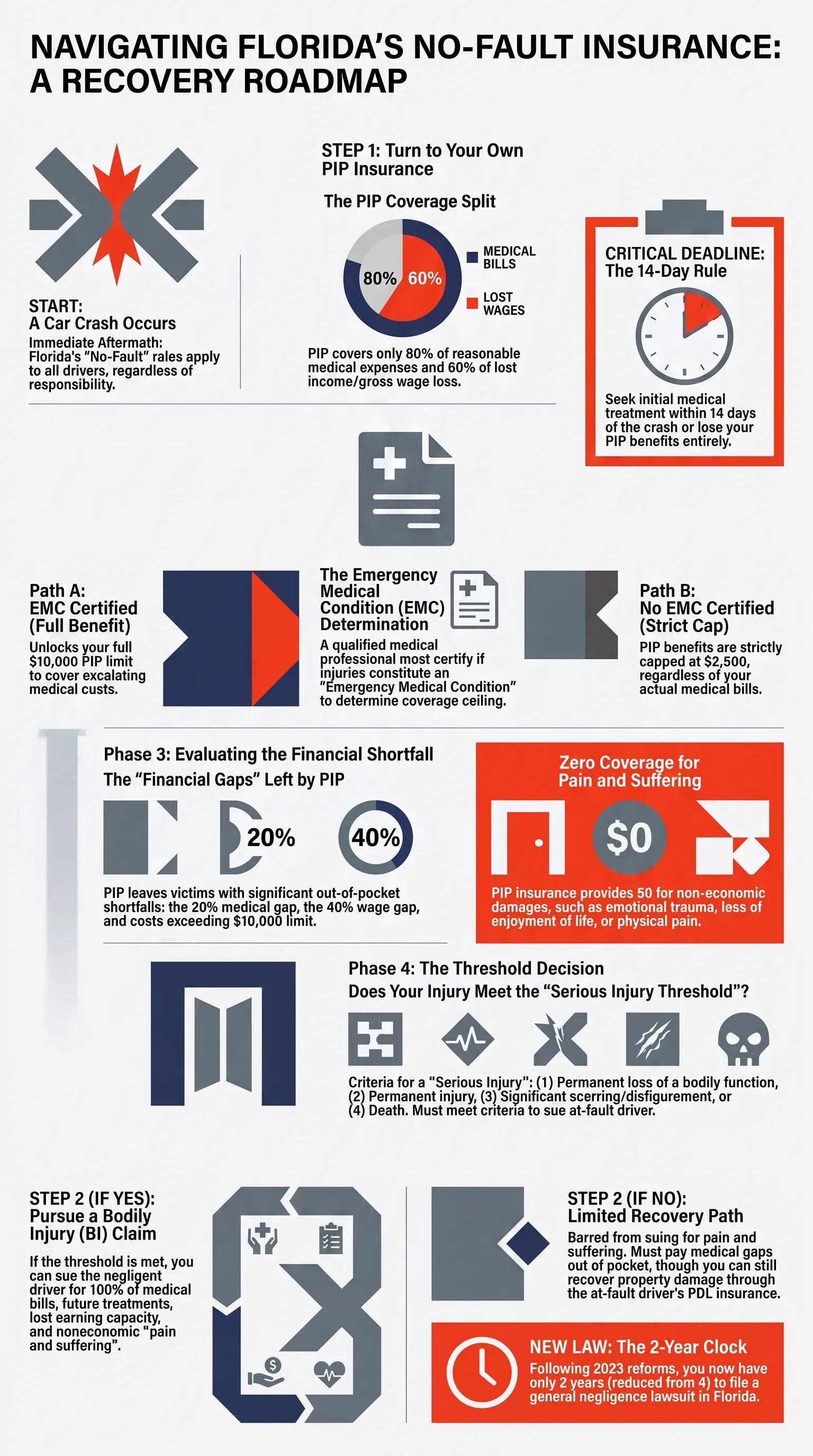
Getting told your car is a 'total loss' is jarring, and the offer that follows is often lower than what it costs to actually replace the car. The good news: the number is negotiable, and Florida law puts some of it on your side. Here's how to check the offer — you can run it through the total-loss calculator in a minute — and how to dispute it.
What 'total loss' and 'ACV' mean
A vehicle is a total loss when the cost to repair it, plus its salvage value, meets or exceeds its actual cash value (ACV) — what the car was worth just before the crash. Florida uses this total-loss formula rather than a single fixed percentage. The insurer then pays you the ACV instead of repairing the car.
The fight is almost always about ACV. Insurers calculate it from a valuation report built on 'comparable' vehicles — and those comps can be cherry-picked low, based on the wrong trim, or adjusted in ways that don't reflect your actual car.
What Florida says you're owed
Two things insurers sometimes leave out of a total-loss payout, but generally owe in Florida under Fla. Stat. § 626.9743 and Fla. Admin. Code r. 69O-170.013:
- Sales tax on the replacement value.
- Title and registration/tag transfer fees.
On a $12,000 car that's roughly $700–$800 extra — real money that belongs in the offer.
How to dispute a lowball offer
- Get the valuation report. Ask the insurer for the written ACV report and the list of comparable vehicles they used.
- Check their comps. Confirm they match your year, trim, options, and mileage — and that they're local. Flag any that are the wrong trim or far away.
- Pull your own comps. Find current listings for the same year, trim, and mileage near you. Save the listings.
- Add tax and fees. Make sure sales tax and title/tag fees are included in the number.
- Send a written counteroffer. Put your comparable value, tax, and fees in writing with your evidence attached, and ask them to justify any gap.
- Invoke the appraisal clause. If you still can't agree, most auto policies let either side demand an independent appraisal to settle the value.
- Escalate if needed. You can file a complaint with the Florida Department of Financial Services, and for a serious dispute, talk to a lawyer.
Two things to watch
If you owe more than the car is worth, the total-loss payout goes to your lender first, and only gap insurance covers the shortfall — the at-fault insurer won't. If you want to keep the car, you usually can, but the insurer subtracts the salvage value and you'll get a salvage title.
Before you accept anything, compare the offer to market value plus tax and fees in the total-loss calculator — it shows the likely shortfall in seconds.
Frequently asked questions
How does an insurance company decide a car is a total loss in Florida?
A car is generally a total loss when the cost to repair it plus its salvage value meets or exceeds its actual cash value (ACV). Florida uses this total-loss formula rather than a single fixed percentage like the 80% rule some states use.
Does insurance have to pay sales tax on a totaled car in Florida?
Generally yes. A Florida total-loss settlement should include sales tax on the vehicle's value, plus title and registration/tag transfer fees — not just the bare cash value. If the offer leaves these out, ask for them.
How is actual cash value (ACV) calculated?
The insurer estimates what your car was worth just before the crash, using comparable local vehicles of the same year, trim, options, and mileage, then adjusts for condition. Because the comparables are chosen by the insurer, ACV is often negotiable.
What is the appraisal clause and when should I use it?
Most auto policies contain an appraisal clause that lets either you or the insurer demand an independent appraisal when you can't agree on the value of a total loss. Each side picks an appraiser, and if they disagree an umpire decides. It's a common way to resolve a lowball ACV.
Can I keep my totaled car in Florida?
Usually yes. If you keep it, the insurer subtracts the salvage value from your payout and the vehicle gets a salvage title, which affects future value and may require inspection before it can be driven legally.
What if I owe more on my car than it's worth?
The total-loss payout goes toward the loan first. If you owe more than the ACV, only gap insurance covers the difference — the at-fault driver's insurer and your own collision coverage do not make up a loan shortfall.
How long do I have to dispute a total-loss offer?
There's no single deadline for negotiating value, but don't sit on it — storage fees can accrue and evidence gets stale. Keep the car available until value is settled, and remember the two-year negligence deadline for any related claim against the at-fault driver.
Put this to work on your own case
Free, private tools that track your Florida deadlines, estimate what you'd actually keep after fees, and draft your claim — no account, nothing leaves your phone.
Start here
Related guides
Related reports
This is general information about Florida law, not legal advice. Every crash is different — for advice about your situation, talk to a licensed Florida attorney. Reviewed August 9, 2026.