What You Actually Keep From a Florida Car Accident Settlement
The gross settlement is not what lands in your bank account. Here's how attorney fees, case costs, and medical liens shrink it — and how to estimate your real take-home before you sign anything.
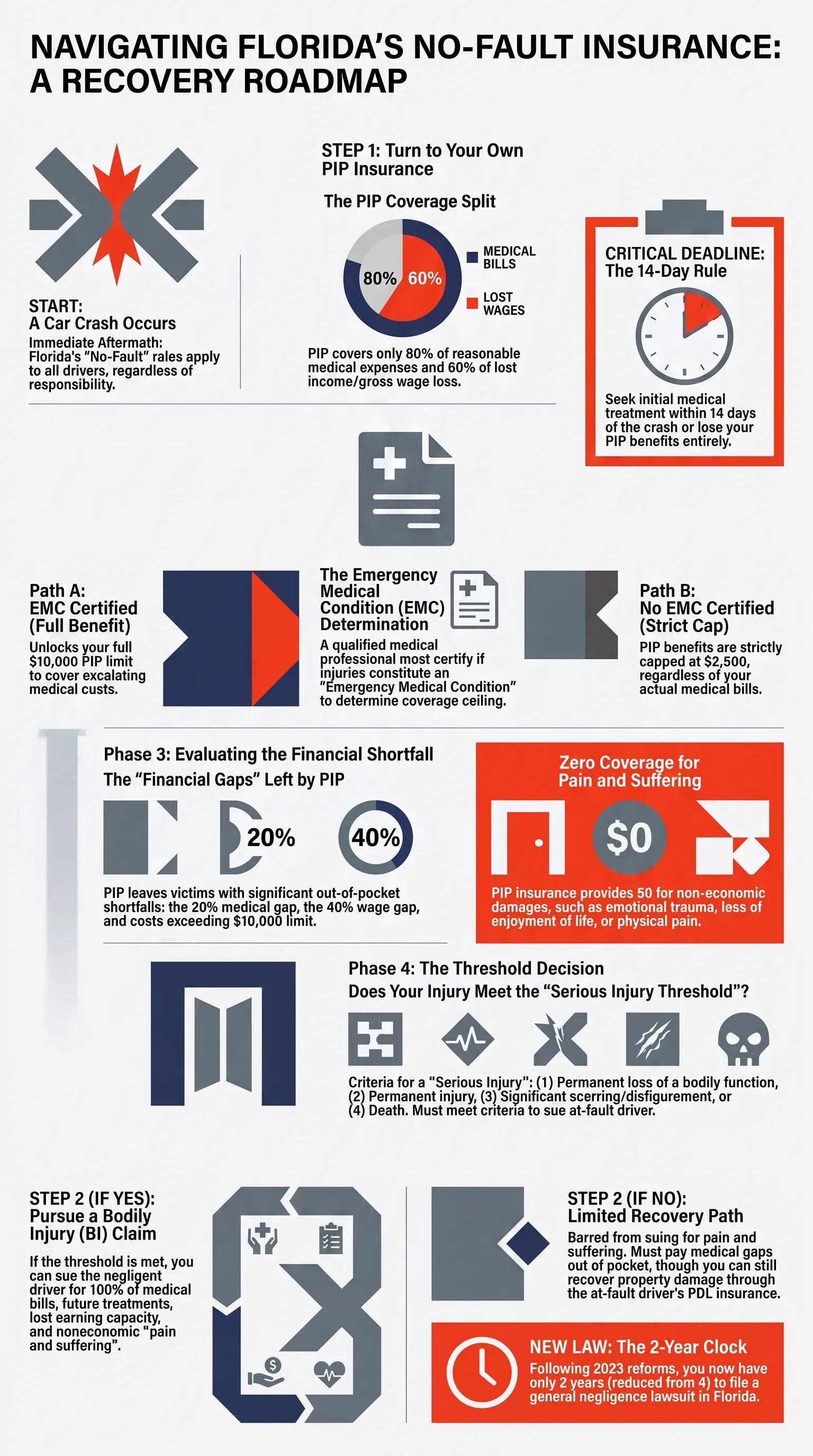
When you hear a car-accident settlement figure, it's almost always the gross — the total the insurer agrees to pay. It is not the number that reaches your bank account. In Florida, several things come out of that gross first, in a fairly predictable order, and what's left over is your net — the number that actually matters.
This guide walks through each deduction, in order, with a worked example. You can run your own numbers in the net-recovery calculator — it does all of this math on your device.
The order things come out
- Your share of fault reduces the claim first.
- The policy limit caps what's actually collectible.
- The attorney's contingency fee comes off the recovery.
- Case costs (filing fees, records, experts) are deducted.
- Medical liens are repaid — after any reductions.
Whatever remains is yours.
Comparative fault and the policy limit
Since HB 837 (2023), Florida uses modified comparative negligence: your recovery drops by your percentage of fault, and if you are found more than 50% at fault you recover nothing. So a $100,000 claim with 20% fault becomes an $80,000 claim.
Then reality: you can usually only collect up to the at-fault driver's insurance limits (plus any umbrella policy or reachable assets). A serious injury worth far more than a $100,000 policy is, in practice, often a $100,000 recovery — which is why knowing the other driver's limits matters so much.
The attorney's fee
Most Florida injury cases run on a contingency fee, and the maximum percentages are set by Florida Bar Rule 4-1.5(f)(4)(B). The common structure is 33 1/3% of any recovery up to $1 million before a lawsuit is filed, rising to 40% once the defendant files an answer (and lower percentages apply to the portions above $1 million). An extra 5% can apply on appeal. These are presumptive maximums — a fee above them requires court approval.
Case costs
Separate from the fee, the case has out-of-pocket costs: court filing fees, medical records, expert witnesses, and the like. These are typically reimbursed to the firm from the recovery. On a modest case they might be a few hundred to a few thousand dollars; on a litigated case with experts, much more.
Medical liens — the part most people forget
If your medical care was paid by someone else, they usually have a right to be repaid from your settlement:
- Health insurance (subrogation). A private health plan can seek reimbursement — but Florida's made-whole doctrine says it generally can't collect until you've been fully compensated, and the common-fund doctrine (and Fla. Stat. § 768.76(4)) make it share a pro-rata part of your attorney fees and costs. Both can meaningfully shrink the lien.
- Medicare and Medicaid. These are statutory 'super-liens' that must be repaid; they cannot simply be ignored. Medicaid's recovery follows a formula in Fla. Stat. § 409.910 and can reach both past and future medical portions.
- Employer (self-funded ERISA) plans. A self-funded ERISA plan with clear plan language can override the made-whole and common-fund protections and be repaid in full — the single biggest wildcard in your net. Whether a plan is truly self-funded is worth an attorney's read.
- Hospital liens / letters of protection. These provider balances are often the most negotiable.
A worked example
Suppose your damages are valued at $150,000, you were 20% at fault, the at-fault driver carries a $100,000 policy, you have a $24,000 private health-insurance lien, and you settle before filing suit with $3,000 in costs:
| Step | Amount |
|---|---|
| Damages | $150,000 |
| Less your 20% fault | $120,000 |
| Capped at the $100,000 policy | $100,000 |
| Less attorney fee (33 1/3%) | −$33,333 |
| Less case costs | −$3,000 |
| Less health lien (after made-whole / common-fund reductions) | −$10,000 to $12,000 |
| Your net | about $52,000 |
The lawyer ad would call this a '$150,000 case.' What you keep is closer to $52,000 — and that's the honest number to plan your life around.
Why the honest number matters
Understanding your net before you sign protects you two ways: it sets realistic expectations, and it lets you weigh a settlement offer against what litigation might actually add after the extra fees and time. A number that looks big can shrink fast; a smaller, faster settlement sometimes nets more than a larger, slower one.
Estimate your own take-home range in the net-recovery calculator — it applies your fault, the policy limit, the fee, costs, and liens on your device, and never sends anything anywhere.
Frequently asked questions
How much of a car accident settlement do you actually keep in Florida?
Less than the gross figure. After your share of fault, the policy-limit cap, the attorney's contingency fee, case costs, and any medical liens, a claimant often keeps roughly a third to a half of the gross. On a $150,000 gross case capped by a $100,000 policy, the take-home is commonly around $45,000–$55,000.
How much does a personal injury lawyer take in Florida?
Florida Bar Rule 4-1.5(f)(4)(B) caps contingency fees. The common structure is 33 1/3% of any recovery up to $1 million before a lawsuit is filed, rising to 40% after the defendant files an answer, with lower percentages on the portions above $1 million and an extra 5% possible on appeal. Case costs are charged separately.
What is a medical lien and how does it affect my settlement?
A medical lien is a right of someone who paid for your care — a health insurer, Medicare, Medicaid, or a hospital — to be repaid from your settlement. It comes out of your share, not the lawyer's, so it directly reduces your net. Florida's made-whole and common-fund doctrines can reduce many liens.
Do I have to pay back Medicare or Medicaid from my car accident settlement?
Yes. Medicare and Medicaid are statutory 'super-liens' that must be repaid from a settlement and cannot be ignored — ignoring a Medicare lien can expose the parties to double damages. Florida Medicaid's recovery follows a formula in Fla. Stat. § 409.910 and can reach both past and future medical portions.
Does my health insurance get reimbursed from a car accident settlement?
Often, through subrogation. But in Florida the made-whole doctrine generally blocks a health insurer from collecting until you've been fully compensated, and the common-fund doctrine (and Fla. Stat. § 768.76(4)) makes it bear a pro-rata share of your attorney fees and costs — so the amount it actually recovers is frequently less than the face of the lien.
What is the made-whole doctrine?
It's a Florida equitable rule that an insurer or other subrogated party cannot recover from your settlement until you have been fully compensated for your loss. When a policy limit or shared fault leaves you short of full compensation, made-whole can reduce or even eliminate what a health-plan lien can claim. Clear contract language can waive it, and self-funded ERISA plans can override it.
How does my share of fault reduce my settlement in Florida?
Under HB 837 (2023), Florida uses modified comparative negligence: your recovery is reduced by your percentage of fault, and if you are more than 50% at fault you recover nothing from the other driver. So being 20% at fault turns a $100,000 claim into $80,000.
Can I recover more than the at-fault driver's insurance policy limit?
Usually not directly. Recovery is realistically capped by the at-fault driver's liability limits plus any umbrella policy or personally reachable assets. If the at-fault driver is uninsured or underinsured, your own uninsured/underinsured motorist (UM/UIM) coverage may fill part of the gap.
How is my net settlement calculated?
Start with the gross, reduce it by your percentage of fault, cap it at the available insurance, then subtract the attorney's contingency fee, case costs, and medical liens (after any made-whole or common-fund reductions). What remains is your net. The free net-recovery calculator does this on your device and shows a range.
Put this to work on your own case
Free, private tools that track your Florida deadlines, estimate what you'd actually keep after fees, and draft your claim — no account, nothing leaves your phone.
Start here
Related guides
Related reports
This is general information about Florida law, not legal advice. Every crash is different — for advice about your situation, talk to a licensed Florida attorney. Reviewed August 9, 2026.