How Much Is My Florida Car Accident Claim Worth?
What actually drives the value of a Florida car-accident claim — and why the number that matters is what you keep after fees, liens, and your share of fault, not the headline figure.
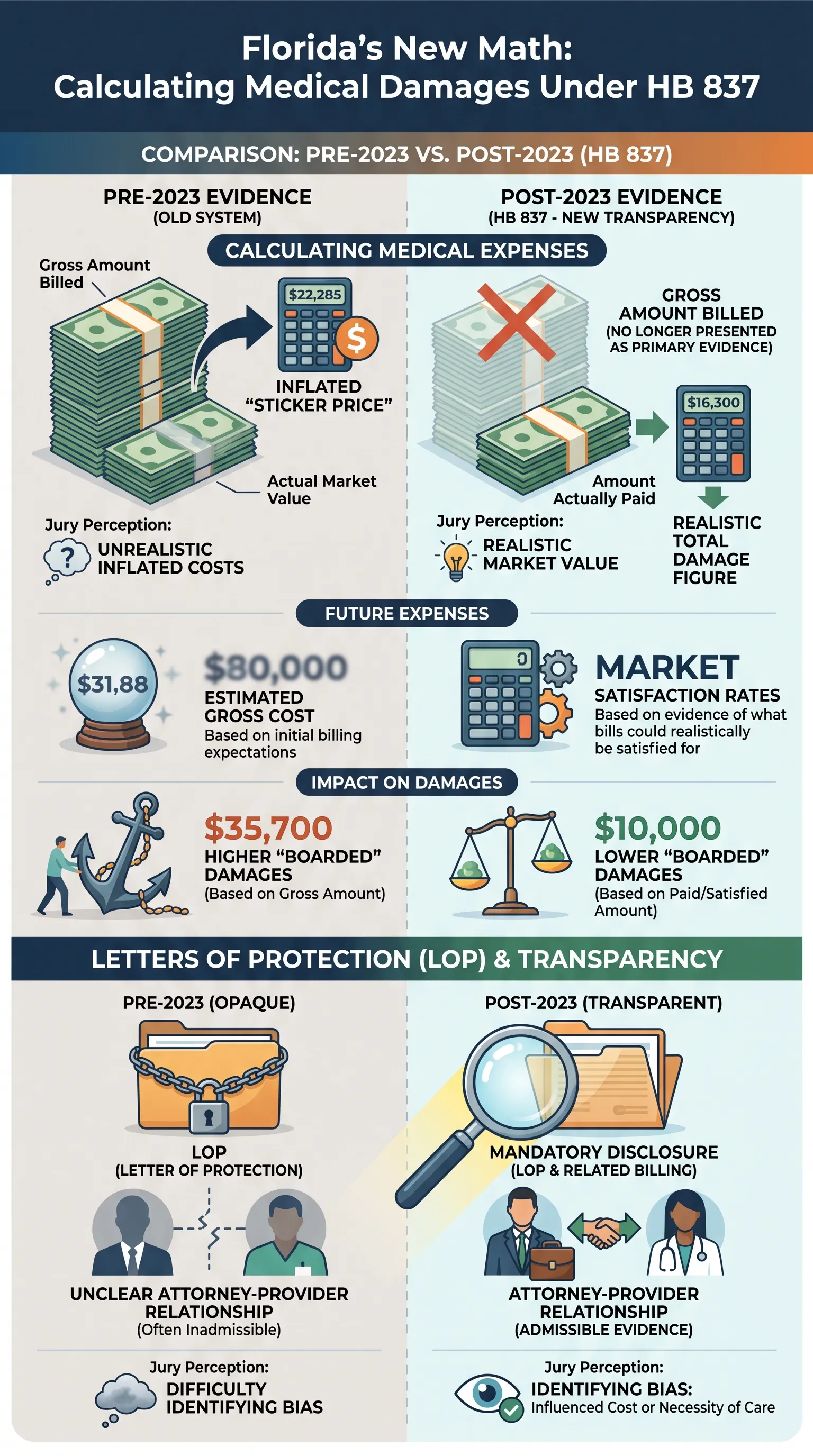
There's no chart that spits out what a car-accident claim is 'worth' — but the value isn't random either. It's built from a few components, then cut down by a few realities. Here's how to think about it, and how to put a realistic range on your own case with the claim-value and net-recovery calculators.
What adds up the value
Economic damages (your 'specials') are the concrete, provable losses:
- Past and future medical bills
- Lost wages and lost future earning capacity
- Out-of-pocket costs and property damage
Non-economic damages are pain, suffering, inconvenience, and loss of enjoyment of life. In Florida you can only recover these from the at-fault driver if your injury meets the serious-injury threshold (a permanent injury, significant scarring or disfigurement, and the like). There's no fixed formula; a common rough method multiplies your economic specials by roughly 1.5x to 5x, scaled by how serious and lasting the injury is.
What cuts it down
Your share of fault. Since HB 837 (2023), Florida uses modified comparative negligence: your recovery drops by your percentage of fault, and if you're more than 50% at fault you recover nothing.
The policy limit. This is the big one people miss. You can usually only collect up to the at-fault driver's liability limits (plus any umbrella or reachable assets). A claim 'worth' $200,000 against a $50,000 policy is, in practice, often a $50,000 claim — unless you have underinsured-motorist (UIM) coverage to reach further.
The number that actually matters: your net
Even the collectible figure isn't what you keep. The attorney's contingency fee (commonly 33 1/3% before suit), case costs, and any medical liens come out first. So a $100,000 recovery can net somewhere around $50,000. Before you judge any offer, run it through the what-you-actually-keep math — that's the number to plan your life around.
A realistic way to estimate
- Add up your economic specials (bills + wages + future costs).
- If your injury is serious/permanent, apply a pain-and-suffering multiple to get a gross range.
- Reduce by your share of fault.
- Cap it at the available insurance.
- Subtract the fee, costs, and liens to get your net range.
The calculators do steps 2–5 for you on your device. Treat the output as a range that tightens as your treatment finishes and liability becomes clear — not a promise.
Be skeptical of any ad or 'settlement estimator' that hands you one confident number up front. Value depends on facts that aren't known yet — the honest answer is always a range.
Frequently asked questions
How much is my car accident claim worth in Florida?
It depends on your economic damages (medical bills, lost wages, future costs), whether your injury is serious enough to add pain-and-suffering, your share of fault, and the at-fault driver's insurance limits. Minor-injury claims are often a few thousand dollars; serious, permanent-injury claims can reach six figures — but the collectible amount is usually capped by the available policy.
How is pain and suffering calculated in Florida?
There's no fixed formula. A common rough method multiplies your economic 'specials' (medical bills and lost wages) by about 1.5 to 5 times, depending on how severe and permanent the injury is. You can only recover pain and suffering from the at-fault driver if your injury meets Florida's serious-injury threshold.
Does my share of fault reduce what my claim is worth?
Yes. Under HB 837 (2023), your recovery is reduced by your percentage of fault, and if you're found more than 50% at fault you recover nothing from the other driver.
Can my claim be worth more than the other driver's insurance?
The claim can be valued higher, but you usually can only collect up to the at-fault driver's liability limits plus any umbrella policy or reachable assets. If they're underinsured, your own uninsured/underinsured motorist (UIM) coverage may cover the gap.
What's the difference between what my claim is worth and what I take home?
The 'worth' is the gross value; your take-home is the net after the attorney's contingency fee, case costs, and medical liens are paid. The net is often roughly a third to a half of the gross, so always look at the net before evaluating an offer.
Should I trust an online settlement calculator's number?
Use it as an informational range, not a valuation. A good estimator shows a range and is transparent about its assumptions; be wary of any tool or ad that promises one exact figure before your treatment and the liability facts are settled.
Does a bigger medical bill mean a bigger settlement?
Higher, reasonable, medically necessary bills generally increase economic damages and can raise the pain-and-suffering multiple. But padded or unnecessary treatment can hurt your credibility, and liens against those bills come back out of your recovery — so more billing doesn't automatically mean more net.
Put this to work on your own case
Free, private tools that track your Florida deadlines, estimate what you'd actually keep after fees, and draft your claim — no account, nothing leaves your phone.
Start here
Related guides
Related reports
This is general information about Florida law, not legal advice. Every crash is different — for advice about your situation, talk to a licensed Florida attorney. Reviewed August 9, 2026.