Diminished Value Claims in Florida: How to Get Paid
Even a flawless repair can't erase your car's accident history — and that history costs you money at resale. Here's how to recover it from the at-fault driver's insurer in Florida.
You did everything right. You weren't at fault, you got your car fixed at a good body shop, and the panels line up perfectly. So here's the uncomfortable truth nobody mentions at the repair desk: your car is now worth less than it was the morning of the crash — and that gap is real money you can often recover.
That lost value has a name: diminished value, or DV. This guide explains exactly what it is, why Florida law lets you claim it, how insurers try to shrink the number with the famous "17c formula," and the step-by-step way to fight back and get paid. It's educational, not legal advice — but by the end you'll know more about DV than most adjusters expect you to.
What "diminished value" actually means
Diminished value is the difference between what your vehicle was worth before the crash and what it's worth after it's been repaired. Even a body shop that does museum-quality work can't change one thing: your car now carries a permanent accident record on Carfax, AutoCheck, and the NMVTIS database. The next buyer sees "Accident reported" and expects a discount. The dealer taking it on trade offers you less. That perception gap is a genuine financial loss, and it's yours to recover.
There are three flavors of DV, and it's worth knowing which one you're claiming:
- Inherent diminished value. This is the big one and the type nearly every claim is about. It's the loss that exists simply because the car has an accident history, assuming repairs were done correctly. A properly fixed car is still worth less than an identical one that was never hit.
- Repair-related diminished value. Extra loss caused by poor repairs — mismatched paint, wavy panels, aftermarket parts, or shortcuts. This stacks on top of inherent DV.
- Immediate diminished value. The value drop measured right after the crash, before any repair. It mostly matters in total-loss math, not everyday claims.
When people say "diminished value claim" in Florida, they almost always mean inherent DV — the resale hit that survives even a great repair.
Why Florida DV is a third-party claim (against the OTHER driver)
Florida is a no-fault state, which confuses a lot of people here. No-fault (your PIP coverage) is about medical bills and injuries — it has nothing to do with your car's resale value. So forget PIP for DV; it's the wrong tool.
Diminished value is a property-damage loss, and property damage in Florida still runs on old-fashioned fault rules. That means the path to getting paid is a third-party claim against the at-fault driver's liability insurer. You're essentially saying: your insured damaged my property, a proper repair didn't make me whole, and the leftover lost value is a real cost you owe me. Florida law supports this, and only a driver who was not at fault can bring it.
Can you claim DV from your OWN insurance?
Usually no. In State Farm v. Mabry's Florida cousin, Siegle v. Progressive, the Florida Supreme Court held that a standard Florida collision policy — one that lets the insurer repair, replace, or pay actual cash value — does not obligate your own carrier to also pay inherent diminished value once it has properly repaired your car. So first-party DV in Florida generally fails unless your specific policy contains explicit language promising it, which is rare. The main exception where you'd look to your own coverage: the at-fault driver is uninsured, and you have Uninsured Motorist Property Damage (UMPD) — then your UM claim may open the door. Otherwise, aim at the at-fault carrier.
The 17c formula: where it came from and why insurers love it
Sooner or later an adjuster will mention the "17c formula." Here's the honest backstory so you're not intimidated by it.
The formula was born in a Georgia class action, State Farm Mutual Automobile Insurance Co. v. Mabry (2001), involving more than 25,000 claimants. The Georgia Supreme Court told State Farm to come up with a method to measure diminished value. State Farm produced a formula, and because it appeared in paragraph 17, section (c) of the court order, everyone started calling it "17c." The court gave it temporary approval for that case only.
That's the key point insurers gloss over: 17c was a settlement tool for one Georgia lawsuit — it is not Florida law, it is not endorsed by any insurance commissioner, and it is not a legal cap on what you can recover. It became popular because insurers nationwide adopted it, since it reliably produces small numbers. Under the Mabry decision itself, the burden is on the insurer to prove its valuation method is appropriate, and you always have the right to a second opinion.
How the 17c math works
The formula multiplies three things together:
- Step 1 — Base loss. Start with 10% of your car's pre-accident value (its Actual Cash Value, or ACV). Many insurers then cap this base figure at $2,500 — a purely arbitrary ceiling from the original case that has no basis in Florida law.
- Step 2 — Damage multiplier. Multiply by a number from 0.00 to 1.00 based on how severe the structural damage was.
- Step 3 — Mileage multiplier. Multiply again by a number from 0.00 to 1.00 based on your odometer. The more miles, the smaller the multiplier — and if you're over 100,000 miles, the multiplier is 0.00, which zeroes out the entire claim.
Here are the two multiplier tables insurers use:
17c damage multiplier
| Multiplier | Severity of structural damage |
|---|---|
| 1.00 | Severe structural damage |
| 0.75 | Major damage to structure and panels |
| 0.50 | Moderate damage to structure and panels |
| 0.25 | Minor damage to structure and panels |
| 0.00 | No structural damage; panels only replaced |
17c mileage multiplier
| Odometer at time of loss | Multiplier |
|---|---|
| 0 – 19,999 miles | 1.00 |
| 20,000 – 39,999 miles | 0.80 |
| 40,000 – 59,999 miles | 0.60 |
| 60,000 – 79,999 miles | 0.40 |
| 80,000 – 99,999 miles | 0.20 |
| 100,000+ miles | 0.00 |
A worked 17c example (with real numbers)
Let's run an actual case so you can see how quickly the number shrinks — and why you should treat it as a floor, not a ceiling.
Say you drive a 2023 SUV worth $30,000 before the crash. It had 35,000 miles and suffered moderate structural damage that was properly repaired.
- Step 1 — Base loss: 10% of $30,000 = $3,000. But the insurer applies the $2,500 cap, so the base drops to $2,500.
- Step 2 — Damage multiplier: moderate structural damage = 0.50. Now $2,500 × 0.50 = $1,250.
- Step 3 — Mileage multiplier: 35,000 miles falls in the 20,000–39,999 band = 0.80. Now $1,250 × 0.80 = $1,000.
17c result: $1,000.
Look at what just happened. Your $30,000 vehicle took a permanent accident hit, and the formula whittled the payout down to a thousand dollars in three quick moves — the $2,500 cap alone erased $500, and each multiplier shaved off more. In the real used-car market, a $30,000 SUV with a moderate accident on its history can easily lose $2,500 to $4,000 of resale value. That's the gap between the 17c starting bid and what your loss actually is — and closing that gap is the whole game. Our diminished-value calculator runs this math for your specific car so you know both numbers before you ever call the insurer.
How to file a Florida diminished value claim, step by step
Here's the sequence that works.
- Confirm you weren't at fault. Third-party DV only works if the other driver caused the crash. Pull the crash report and check the fault findings.
- Fully repair the car first. You can't measure inherent DV until repairs are done. Keep every repair invoice, parts list, and paint record — especially anything showing structural or frame work, which drives value loss.
- Document the vehicle's condition. Gather the repair invoice, the crash report, photos of the damage and the finished repair, your service history, and a current valuation showing the pre-accident ACV. If you're unsure what the damage was worth, our damage-estimate tool helps you put a number on it.
- Get an independent DV appraisal. This is the single most important piece of evidence. (Full details in the next section.)
- Write a demand letter to the at-fault insurer. Send a clear written demand that states your claim number, the pre-accident value, the post-repair value, the dollar amount of diminished value, and your supporting documents. Attach the appraisal, invoices, photos, and comparable listings. Put a specific dollar figure on the table.
- Negotiate. Expect a lowball 17c counteroffer. Counter with your evidence. Most DV claims settle here, in a few rounds of letters or emails.
- Escalate if needed. If they won't move, you can file suit in small claims (up to $8,000 in Florida) or county court, or bring in an attorney. Many DV amounts fit neatly in small claims.
How to get an independent appraisal (and why it matters)
The insurer's 17c number carries no special legal weight. A credible independent appraisal, on the other hand, is hard for an adjuster to ignore — and in any dispute it carries far more weight than the formula.
What to look for in an appraiser:
- Real credentials. Look for appraisers certified by the ASA (American Society of Appraisers) or affiliated with the IARA (International Automotive Remarketers Alliance), with automotive/DV experience.
- Market-based method. A good appraiser establishes your car's true pre-accident value, then measures the resale loss using actual comparable sales and dealer feedback — not a generic 10% formula. This market approach typically produces a higher, better-supported number than 17c.
- A written report you can attach. You want a signed report with the methodology spelled out, so it doubles as evidence in negotiation or court.
A professional DV appraisal usually costs somewhere in the low hundreds of dollars. If your claim is worth a few thousand, that's a strong return — and you can ask the at-fault insurer to reimburse the appraisal cost as part of your damages. You can also build your own supporting file for free: pull dealer trade-in quotes on your exact car (once disclosing the accident history, once not, to show the spread) and screenshot comparable listings of clean-history versions of your vehicle to prove the market gap.
Negotiation tips that actually move the number
- Anchor high, with evidence. Lead with your appraisal figure, not the insurer's. The first credible number on the table shapes everything after it.
- Make them justify 17c. Ask the adjuster to explain, in writing, why an arbitrary Georgia settlement formula should override a market-based appraisal of your specific car. Remember: the burden is on them to show their method is appropriate.
- Attack the cap and the multipliers. Point out that the $2,500 base cap and the mileage multiplier have no basis in Florida law and don't reflect real resale behavior — a well-kept car with 35,000 miles doesn't lose 20% of its DV just for crossing 20,000 miles.
- Use the paper trail. Dealer quotes and comparable listings are concrete and persuasive. "Here are three dealers who dropped their trade-in offer $3,000 after seeing the Carfax" beats any formula.
- Stay businesslike and patient. DV claims are a negotiation. A calm, well-documented back-and-forth over a couple of weeks usually beats an angry phone call.
Common insurer pushback — and how to answer it
| What the adjuster says | How to respond |
|---|---|
| "We use the 17c formula, that's the standard." | 17c was a temporary tool for one Georgia case, not Florida law and not a cap. Offer your independent market appraisal instead. |
| "Your car was repaired properly, so there's no loss." | A perfect repair doesn't erase the accident record. Inherent DV is exactly the loss that remains after a good repair. |
| "Florida doesn't recognize diminished value." | Florida recognizes third-party DV against the at-fault driver. It's a property-damage tort claim, separate from PIP. |
| "You have too many miles / the car's too old." | Mileage affects the amount, not your right to claim. Show comparable listings proving the market still discounts your car. |
| "You need to prove the exact loss." | That's what your appraisal, dealer quotes, and comps do. Put them in writing and demand a specific figure. |
Your deadline: the Florida statute of limitations
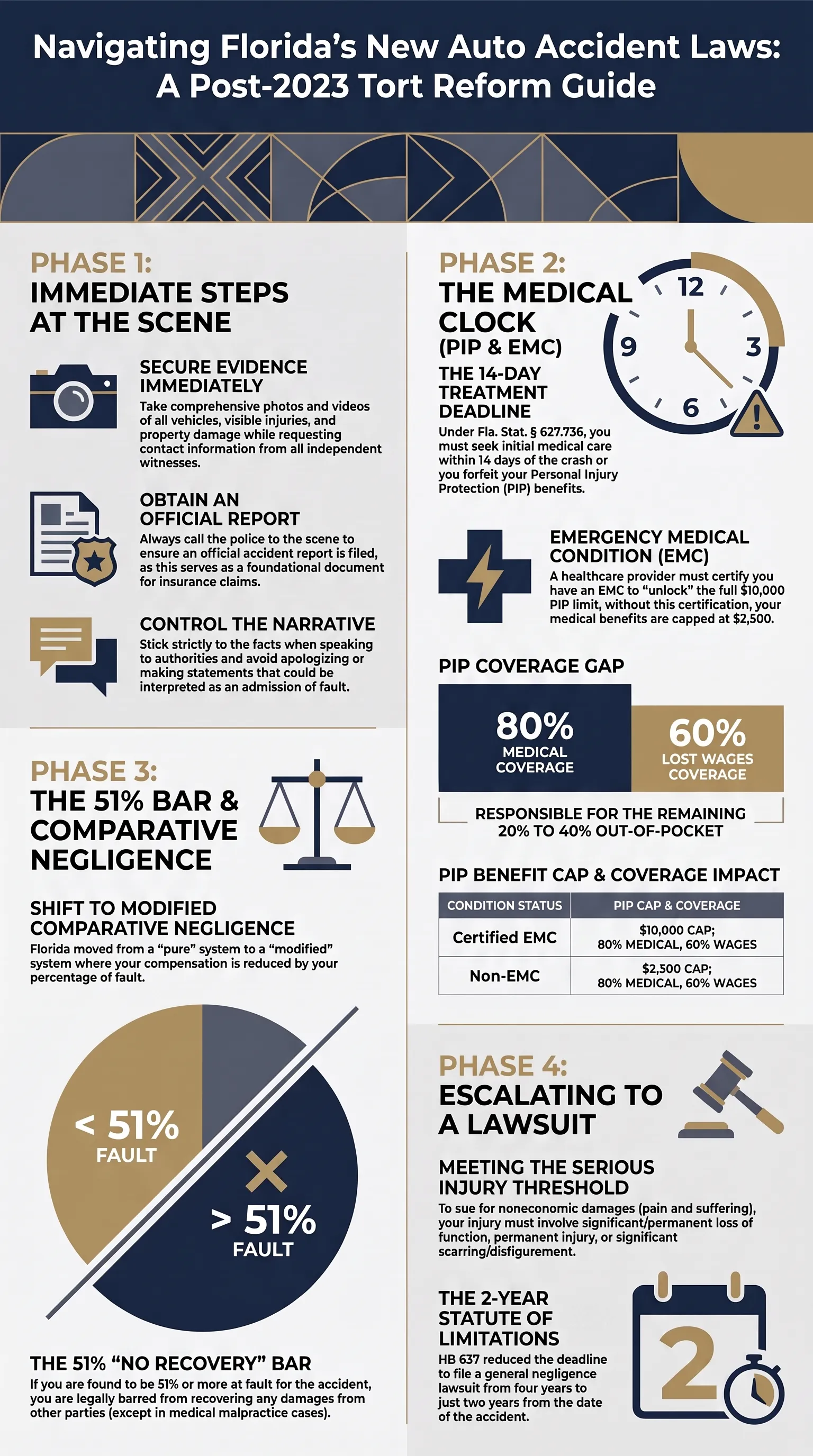
This one changed recently, so pay attention. Diminished value is a negligence-based property-damage claim. Under Florida's tort-reform law HB 837, effective March 24, 2023, the statute of limitations for negligence was cut from four years to two years for claims accruing on or after that date.
In plain terms: if your crash happened on or after March 24, 2023, assume you have 2 years from the date of the accident to settle or file suit on your DV claim. (Older crashes may still fall under the previous 4-year rule.) You'll still see outdated articles citing "4 years" — don't rely on them. When in doubt, act early, and treat the 2-year clock as your deadline.
When is a DV claim worth pursuing?
DV claims aren't worth it for every fender-bender. It makes the most sense when several of these are true:
- You were not at fault and the at-fault driver has liability coverage (or you have UMPD).
- Your car is newer and lower-mileage. A 2-year-old vehicle with 30,000 miles has far more value to lose than a 12-year-old car with 160,000 miles.
- The damage was significant — structural or frame repairs, airbag deployment, or major panel replacement — because that's what buyers discount hardest.
- The car had real market value to begin with. The higher the pre-accident value, the bigger the potential DV.
If your car is old, high-mileage, and took only cosmetic damage, the realistic recovery may be small. But if you're driving a recent, desirable vehicle that now wears an accident report, DV can be worth thousands — and the effort is mostly paperwork.
Set your expectations, then go get it
Realistically, most Florida DV claims settle somewhere between the insurer's rock-bottom 17c number and your independent appraisal. Your job is to drag that settlement toward the appraisal with solid evidence and steady negotiation. Plenty of people recover a few thousand dollars for a claim that would have paid a few hundred — purely because they showed up with documentation and knew the 17c number was just an opening bid.
Start by running your own numbers with our diminished-value calculator and sizing up the hit with the damage-estimate tool, gather your paperwork, get an appraisal if the stakes justify it, and send a clear written demand. The at-fault insurer is counting on you not knowing any of this. Now you do.
This guide is educational and not legal advice. For advice about your specific situation, consult a licensed Florida attorney.
Frequently asked questions
What is a diminished value claim?
It's a claim to recover the resale value your vehicle loses just because it now has an accident on its history report — even after it's been fully and properly repaired. Buyers and dealers pay less for a car with a reported accident, and that lost value is what you're recovering.
Can I file a diminished value claim in Florida?
Yes, if you were not at fault. Florida recognizes third-party diminished value claims against the at-fault driver's liability insurer. It's treated as a property-damage claim under traditional fault rules, separate from Florida's no-fault PIP system, which only covers injuries.
Can I claim diminished value from my own insurance company?
Usually no. In Siegle v. Progressive, the Florida Supreme Court held that a standard Florida collision policy doesn't require your own insurer to pay inherent diminished value after properly repairing your car. Unless your specific policy has explicit DV language, aim the claim at the at-fault driver's insurer. If that driver is uninsured, your Uninsured Motorist Property Damage (UMPD) coverage may apply.
What is the 17c formula and is it Florida law?
The 17c formula (10% of value, reduced by a damage multiplier and a mileage multiplier) came from a Georgia class action, State Farm v. Mabry. It got temporary approval for that one case only. It is not Florida law, not endorsed by any insurance commissioner, and not a legal cap on your recovery. Insurers use it because it produces small numbers — treat it as an opening bid.
How much diminished value can I actually recover?
It depends on your car's value, age, mileage, and how severe the damage was. The 17c formula often produces a few hundred to about a thousand dollars, but a newer, low-mileage vehicle with structural damage can genuinely lose several thousand dollars of resale value. An independent appraisal usually supports a higher figure than 17c.
Do I need an independent appraisal to file?
You don't strictly need one, but it's the strongest evidence you can bring. A written appraisal from an ASA-certified or IARA-affiliated appraiser measures your car's real market loss and carries far more weight than the insurer's formula in negotiation or court. Expect to pay a few hundred dollars, and you can ask the at-fault insurer to reimburse that cost.
How long do I have to file a diminished value claim in Florida?
Diminished value is a negligence property-damage claim. Under HB 837, effective March 24, 2023, Florida's negligence statute of limitations dropped from four years to two years for claims accruing on or after that date. If your crash was on or after March 24, 2023, assume a 2-year deadline from the accident date and act early.
Does high mileage kill my diminished value claim?
It reduces the amount but not your right to claim. The 17c mileage multiplier drops to zero above 100,000 miles, which insurers use to deny claims — but that's a formula quirk, not law. If comparable listings show the market still discounts your car, you can argue for a real recovery regardless of the multiplier.
Can I get diminished value if my car was a total loss?
No. Diminished value applies to cars that were damaged, repaired, and put back on the road. If the vehicle is declared a total loss, there's no repaired car to lose resale value — that claim is handled as a total-loss (actual cash value) settlement instead.
What documents do I need for a diminished value claim?
Typically: the crash report showing the other driver was at fault, all repair invoices (especially anything showing structural work), before-and-after photos, your service records, a current valuation of the pre-accident value, and an independent diminished value appraisal. Dealer trade-in quotes and comparable listings strengthen the file further.
Put this to work on your own case
Free, private tools that track your Florida deadlines, estimate what you'd actually keep after fees, and draft your claim — no account, nothing leaves your phone.
Start here
Related guides
Related reports
This is general information about Florida law, not legal advice. Every crash is different — for advice about your situation, talk to a licensed Florida attorney. Reviewed August 6, 2026.