Statute of Limitations for Florida Car Accidents (Now 2 Years)
Since HB 837, most Florida crash lawsuits must be filed within two years, not four. Here is the deadline that decides whether your claim survives, and the other clocks running right now.
If you were hurt in a Florida car crash, one date matters more than almost any other: the last day you can file a lawsuit. Lawyers call it the statute of limitations. Cross that line and the courthouse door closes, usually for good, even if the other driver was clearly at fault and your injuries are serious.
Here is the part that trips people up in 2026: Florida cut this deadline roughly in half a few years ago. For most crashes it used to be four years. Now it is two. This guide walks you through exactly what changed, who it affects, the other deadlines quietly running alongside it, and what to do so a paperwork clock never decides your case for you.
This is general education about Florida law, not legal advice about your specific situation. Deadlines have exceptions, and only a licensed Florida attorney who knows your facts can tell you your true cutoff date.
The short answer
For a typical car-accident injury caused by another driver's carelessness, if your crash happened on or after March 24, 2023, you generally have two years from the date of the crash to file a personal-injury lawsuit in Florida. That rule lives in Fla. Stat. § 95.11(4)(a).
If your crash happened before March 24, 2023, the older four-year deadline generally still applies to your claim. More on that important wrinkle below.
Every crash deadline at a glance
A car crash does not start one clock. It starts several, and they run at very different speeds. Here are the big ones for a typical Florida collision.
| Deadline | What it is | Where it comes from |
|---|---|---|
| 14 days | See a doctor to keep your PIP no-fault medical benefits. This is NOT a lawsuit deadline, but miss it and you can lose up to $10,000 in coverage. | Fla. Stat. § 627.736 |
| Promptly | Report the crash to your own insurer as your policy requires. Late notice can be used to deny a claim. | Your auto policy contract |
| 2 years | File a personal-injury lawsuit for a crash on/after March 24, 2023 (negligence). | Fla. Stat. § 95.11(4)(a) |
| 2 years | File a wrongful-death lawsuit if someone died in the crash (measured from the date of death). | Fla. Stat. § 95.11(4)(d) |
| 4 years | File a personal-injury lawsuit for a crash that happened BEFORE March 24, 2023 (old negligence rule). | Former Fla. Stat. § 95.11(3)(a) |
| 3 years (2 for death) | Give written notice of a claim against a government entity (a city, county, or state agency, or a government vehicle) before you can sue. | Fla. Stat. § 768.28 |
| 5 years | Sue your own insurer for breach of a written insurance contract (for example, unpaid PIP or underinsured-motorist benefits), measured from the breach. | Fla. Stat. § 95.11(2)(b) |
What changed: the 4-year to 2-year shift (HB 837)
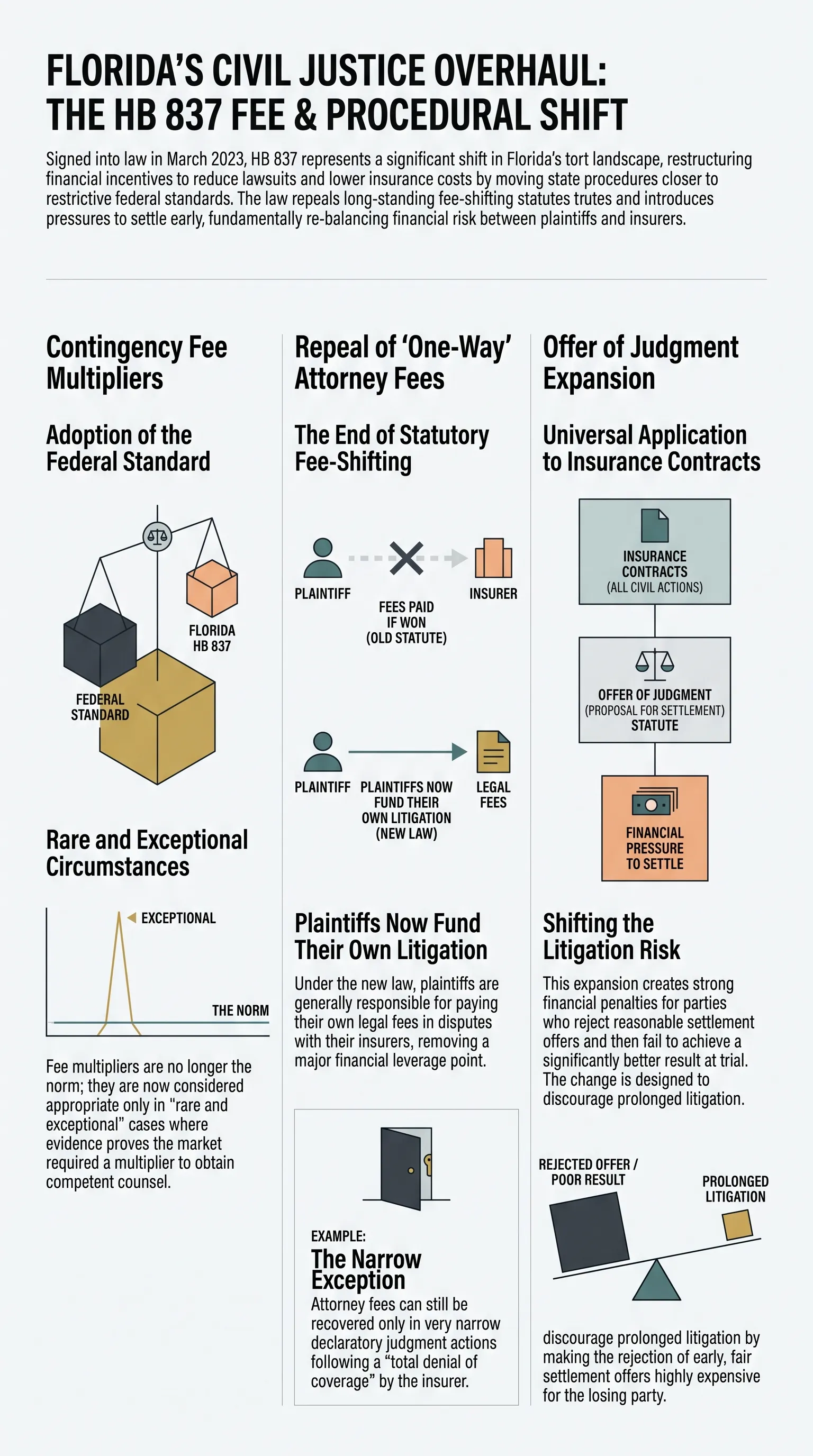
On March 24, 2023, Florida's governor signed a sweeping tort-reform law known as CS/CS/HB 837. Among many changes, it rewrote the general negligence statute of limitations in § 95.11 and cut the filing window for most negligence claims, including car-accident injury claims, from four years down to two.
Lawmakers said the goal was to reduce lawsuit volume and insurance litigation costs. Whatever the policy debate, the practical effect for crash victims is blunt: you now have half as much time as Floridians did before 2023. In the days right before the law took effect, plaintiffs' firms filed hundreds of thousands of cases to lock in the old four-year window, which tells you how much lawyers understood was at stake.
The effective-date rule: which deadline applies to you
This is the single most misunderstood part of the change, so read it slowly. The two-year deadline applies to causes of action that accrued on or after March 24, 2023. In a car crash, your claim usually "accrues" on the day the crash happens.
- Crash on or after March 24, 2023: the new 2-year deadline applies.
- Crash before March 24, 2023: the old 4-year deadline generally still applies. The change was not retroactive, so it did not shorten claims that already existed.
By 2026, nearly every new crash falls squarely under the two-year rule. But if you are dealing with an older accident, or an injury that was slow to surface, the accrual date can genuinely change your deadline, and it is worth confirming with an attorney rather than guessing.
Why this deadline is so unforgiving
People often assume a deadline is a soft target, the way a bill has a grace period. The statute of limitations is not like that. It is one of the hardest lines in civil law.
If you file even one day late, the defendant (usually the at-fault driver's insurance company) can ask the court to dismiss your case, and the judge will almost always grant it. It does not matter that liability was obvious, that your medical bills are enormous, or that you were still recovering. The claim is simply barred forever. You also lose your leverage to settle, because an insurer has little reason to pay a claim you can no longer take to court.
Think of the statute of limitations as the expiration date on your legal rights. After it passes, the strongest case in the world is worth almost nothing.
That is why lawyers file well before the true cutoff. Building a case takes time, evidence disappears, and no responsible attorney wants to be racing a clock that offers zero forgiveness.
Do not confuse the lawsuit deadline with the 14-day PIP deadline
This is the most costly mix-up we see, so it gets its own section. Florida is a no-fault state, which means your own auto policy includes Personal Injury Protection (PIP) that pays up to $10,000 of your initial medical bills and lost wages regardless of who caused the crash.
To keep those benefits, Fla. Stat. § 627.736 requires you to receive initial medical care within 14 days of the crash. Wait longer than two weeks to see a doctor and you can permanently forfeit that PIP coverage.
Notice how different these two clocks are:
- The 14-day PIP rule is about seeing a doctor quickly so your no-fault insurance pays your early bills. It runs out in two weeks.
- The 2-year statute of limitations is about your right to sue the at-fault driver for your full damages. It runs out in two years.
They are separate deadlines with separate consequences. You can blow the 14-day window and still have a valid lawsuit, or vice versa. The safe approach is to treat the crash as a two-track emergency: get medical care within days, and start thinking about your legal claim right away too. Our guide to the 14-day PIP rule covers that shorter clock in detail.
Other deadlines that can catch you off guard
Wrongful death
If a loved one died in a crash, the family's wrongful-death claim also carries a 2-year deadline under Fla. Stat. § 95.11(4)(d). Importantly, this clock generally runs from the date of death, which is not always the date of the crash if the person survived for a time in the hospital.
Claims against a city, county, or state agency
Was the other vehicle a police cruiser, a city bus, a public-works truck, or another government vehicle? Suing a government entity is different. Under Fla. Stat. § 768.28, before you can file suit you must first serve written notice of the claim on the proper agency (and, in many cases, the Florida Department of Financial Services). You generally have three years to present that written claim (only two years for wrongful death), and you usually cannot sue until the agency denies the claim or a waiting period passes. Sovereign-immunity claims also cap the damages the government must pay. These rules are strict and easy to get wrong, so government-involved crashes are a situation where early legal help really matters.
Insurance and PIP contract deadlines
Fights with your own insurer, for example over unpaid PIP benefits or an underinsured/uninsured-motorist (UM) claim, are treated as contract disputes, not negligence. Those generally follow the 5-year deadline for written contracts in Fla. Stat. § 95.11(2)(b), measured from when the insurer breaches (denies or underpays), not from the crash date. That said, your policy itself may impose much shorter notice and cooperation duties, so read it and report claims promptly.
Exceptions that can pause the clock (tolling)
In limited situations, the law "tolls" (pauses) the statute of limitations. These exceptions are narrow, fact-specific, and often litigated, so treat them as reasons to call a lawyer, not as a plan to file late.
Injured minors
When the injured person is a child, Florida law can extend the deadline, because a minor cannot bring a lawsuit on their own. The rules interact with when a parent or guardian knew of the claim, and there are outer limits, so the exact cutoff for a child's claim should always be confirmed with counsel.
Delayed discovery
A claim generally accrues when it happens, but in some cases the clock does not start until you knew, or reasonably should have known, that you were injured and that the injury was connected to the crash. This "delayed discovery" idea is applied cautiously in ordinary car-accident cases, where the injury and cause are usually obvious on day one, but it can matter for injuries that surface later.
The at-fault driver leaves or hides in the state
If the defendant leaves Florida or conceals themselves so they cannot be served, the period of that absence may not count against your deadline in some circumstances. Do not rely on this to sit on your rights, but it can be relevant when a defendant is deliberately hard to find.
Fraudulent concealment and legal incapacity
If a defendant fraudulently hides facts that prevent you from discovering your claim, or if the injured person is legally incapacitated, the clock may be paused for a time. Again, these are exceptions a court decides based on specific evidence, not defaults you should count on.
Step by step: what to do, and when
You do not need to memorize statutes. You need a simple sequence that keeps every clock from running out.
- Within days (ideally within 14): get medical care, even if you feel "mostly fine." This protects your health and your PIP benefits under the 14-day rule.
- Right away: report the crash to your own insurer as your policy requires, and keep every document, photo, and bill. If police responded, get the crash report number.
- Within the first weeks: talk to a Florida personal-injury attorney. A short consultation is usually free and pins down your exact deadline, including any government-notice or accrual wrinkles.
- Well before the 2-year mark: make sure a lawsuit is filed if your claim has not settled. Filing early preserves evidence and negotiating leverage; waiting risks everything.
- Anytime you are unsure: assume your deadline is sooner than you think and act on that assumption. It is far safer to be early than one day late.
Want your dates calculated for you? Use our Florida crash deadline tool to turn your crash date into the specific cutoffs that apply to your situation.
Common mistakes people make with the deadline
- Assuming they still have four years. For crashes since March 2023, that is now wrong and dangerous. It is two.
- Confusing settlement talks with the deadline. Negotiating with an insurer does not pause the statute of limitations. The clock keeps running while you talk.
- Thinking the 14-day PIP rule is the only deadline. It is the fastest, but not the one that decides your lawsuit.
- Forgetting the extra step for government vehicles. The written-notice requirement means you cannot just wait and sue at the last minute.
- Waiting until the final weeks to hire a lawyer. Many good attorneys will not take a case that is about to expire, because there is no time to build it.
The bottom line
Florida's car-accident lawsuit deadline is now two years for crashes on or after March 24, 2023, cut from four by HB 837. It is strict, it is unforgiving, and it is not the same as the 14-day PIP medical deadline or the special notice rules for government claims. The exceptions that pause the clock are real but narrow.
You do not have to navigate the fine print alone. Treat the crash date as day one, get medical care fast, and get a Florida attorney's read on your exact deadline early, long before any clock runs out. Doing that one thing protects everything else.
Frequently asked questions
How long do I have to sue after a car accident in Florida?
For crashes on or after March 24, 2023, you generally have two years from the date of the crash to file a personal-injury lawsuit, under Fla. Stat. § 95.11(4)(a). Crashes before that date generally keep the old four-year deadline.
Why did the deadline change from 4 years to 2 years?
A 2023 tort-reform law, HB 837, rewrote Florida's negligence statute of limitations and cut it from four years to two. It took effect March 24, 2023, and applies to claims that accrued on or after that date.
Does the 2-year deadline apply to my older crash?
Not necessarily. The change was not retroactive. If your crash happened before March 24, 2023, your claim generally still follows the old four-year deadline. Because accrual dates can be tricky, confirm your exact cutoff with a Florida attorney.
Is the 14-day PIP rule the same as the statute of limitations?
No. The 14-day rule requires you to see a doctor within two weeks to keep your PIP no-fault medical benefits under Fla. Stat. § 627.736. The statute of limitations is the separate two-year deadline to file a lawsuit. They are different clocks with different consequences.
What happens if I miss the statute of limitations?
The at-fault party can ask the court to dismiss your case, and the judge almost always will. Your claim is then barred permanently, regardless of how strong it was or how serious your injuries are. You also lose leverage to settle.
What is the deadline for a wrongful-death claim after a fatal crash?
Wrongful-death claims carry a two-year deadline under Fla. Stat. § 95.11(4)(d), and the clock generally runs from the date of death, which is not always the date of the crash.
Are the rules different if a government vehicle caused my crash?
Yes. Under Fla. Stat. § 768.28, you must serve written notice of the claim on the correct agency before suing, generally within three years (two years for wrongful death), and you usually cannot sue until the agency denies the claim or a waiting period passes. Sovereign immunity also caps the damages the government must pay.
Can the deadline ever be paused or extended?
Sometimes. Florida law can toll (pause) the clock in narrow situations, such as an injured minor, a defendant who leaves or hides in the state, fraudulent concealment, legal incapacity, or in limited cases delayed discovery of an injury. These exceptions are fact-specific and litigated, so never assume one applies without legal advice.
Does talking to the insurance company stop the clock?
No. Settlement negotiations do not pause the statute of limitations. The two-year clock keeps running while you talk, which is why lawyers file suit before the deadline even when negotiations are ongoing.
How long do I have to sue my own insurer for unpaid PIP or UM benefits?
Disputes with your own insurer are contract claims, not negligence. They generally follow the five-year deadline for written contracts under Fla. Stat. § 95.11(2)(b), measured from when the insurer breaches, though your policy may impose shorter notice duties.
Put this to work on your own case
Free, private tools that track your Florida deadlines, estimate what you'd actually keep after fees, and draft your claim — no account, nothing leaves your phone.
Start here
Related guides
Related reports
This is general information about Florida law, not legal advice. Every crash is different — for advice about your situation, talk to a licensed Florida attorney. Reviewed August 6, 2026.