Florida's 14-Day Rule After a Car Accident: How to Keep Your PIP Benefits
In Florida, if you don't see the right kind of medical provider within 14 days of your crash, you can lose your entire $10,000 in PIP benefits — here's exactly how to protect them.
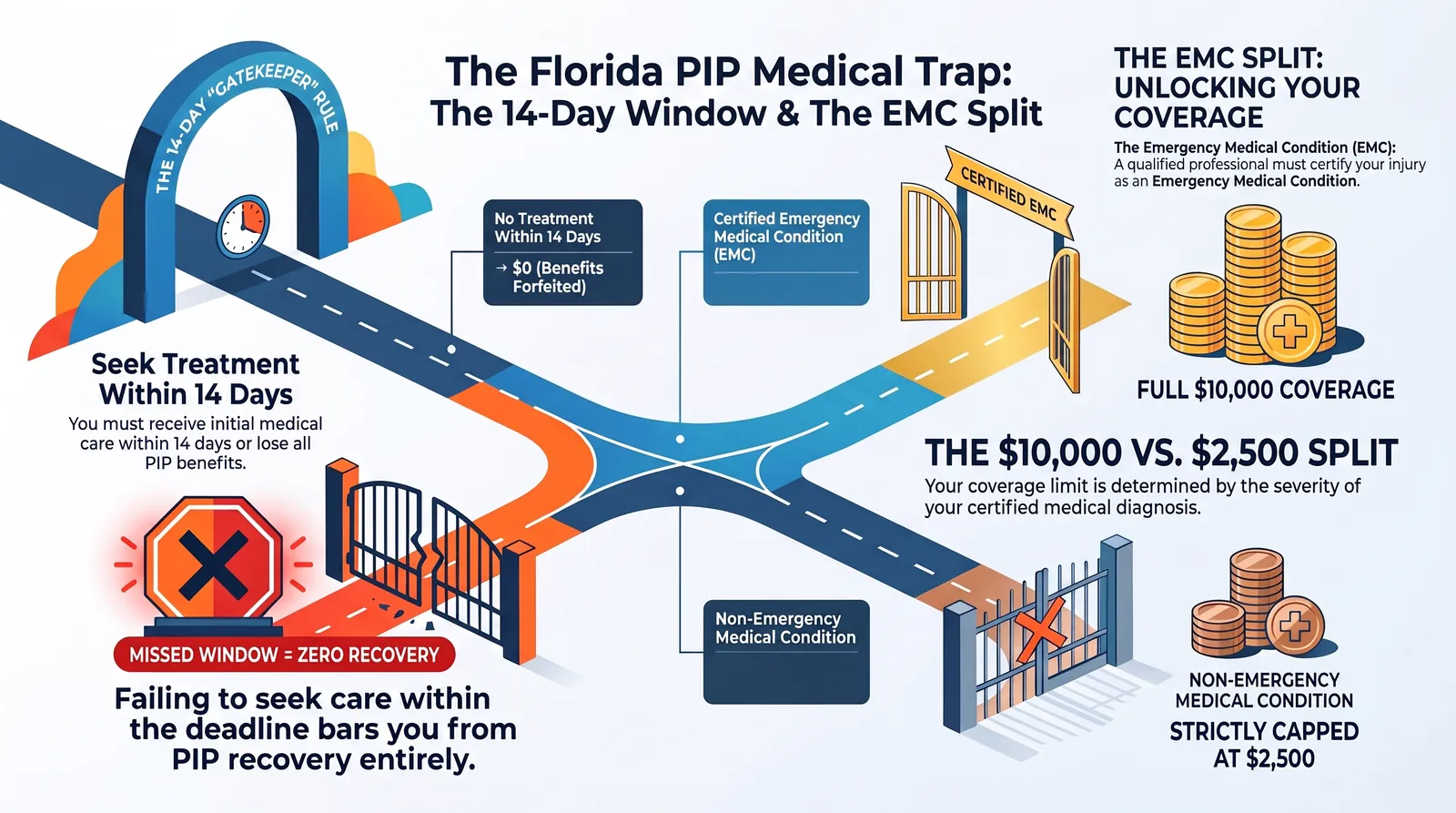
If you were just in a car accident in Florida, you are probably sore, shaken, and buried in questions. Here is the one that can quietly cost you thousands of dollars: did you see a doctor within 14 days? Florida is a no-fault state, which means your own auto insurance pays your first round of medical bills through something called Personal Injury Protection, or PIP. But there is a catch written right into the law — if you do not get the right kind of care within 14 days of the crash, that coverage disappears entirely. Not reduced. Gone.
This guide walks you through exactly what the 14-day rule is, the little-known $10,000-versus-$2,500 trap that surprises almost everyone, who counts as the “right” provider, and the concrete steps to take today. It is written for a real person who just had a scary day — not for a lawyer. Take a breath. You have time to get this right, but not much, so let's move.
The 14-day rule in one sentence
Under Florida law (Fla. Stat. § 627.736), your PIP insurance will only pay for your accident-related medical care if you receive initial services and care within 14 days after the motor vehicle accident. Miss that window, and your insurer can — and almost certainly will — deny every medical bill connected to the crash.
That is the whole rule. It sounds simple, and it is. What trips people up is not understanding the rule; it is not realizing the clock is running while they “wait to see how they feel.”
Why this rule even exists
Florida added the 14-day requirement back in 2012 to fight staged-accident fraud and to stop bills from piling up months after minor fender-benders. Lawmakers wanted proof that injuries were real and connected to the crash, so they demanded prompt treatment by a licensed provider. Whatever you think of the policy, the practical result for you is blunt: the law rewards people who get checked out fast and punishes people who tough it out. Adrenaline and stress can mask whiplash, concussions, and soft-tissue injuries for days — so “I feel okay” on the day of the crash tells you almost nothing.
What “seek care within 14 days” actually means
Let's get precise, because precision is what protects you here.
- The clock starts on the date of the accident. If your crash was on the 1st, day 14 is the 15th of that month. Do not try to cut it close — count generously and go early.
- It is 14 calendar days, not business days. Weekends and holidays count. There is no pause for the clinic being closed.
- “Initial services and care” means an actual medical evaluation by a qualifying provider — being examined, evaluated, and having your injuries documented. A quick phone call or scheduling a future appointment does not count. You need to be seen.
- The statute provides no general exception or extension. It does not care that you were busy, that you didn't feel hurt at first, or that you couldn't get an appointment. If day 14 passes with no qualifying visit, the door closes in nearly every case.
The safest move is to get evaluated within the first day or two — ideally at an ER, urgent care, or your doctor. Early treatment is not just about the deadline; it also creates the medical record that ties your injuries to the crash, which matters enormously later if you have a claim.
The $10,000 vs. $2,500 trap: the “emergency medical condition” that almost nobody explains
This is the most important section in this entire guide, and it is the piece that even careful people miss.
Everyone hears “Florida PIP gives you $10,000.” That is only half true. You get up to $10,000 only if a qualified provider documents that you had an “emergency medical condition” — usually abbreviated EMC. If no one certifies an EMC, your PIP benefits are capped at just $2,500. Same crash, same injuries, but a quarter of the coverage — all because of a piece of paper.
An emergency medical condition is a clinical determination that your injury shows acute symptoms severe enough that, without immediate medical attention, you could reasonably expect serious jeopardy to your health, serious impairment of a bodily function, or serious dysfunction of a body part. In plain English: a provider has to look at you and formally decide your condition was serious enough to need prompt care, and write it down.
If a provider examines you and determines you did not have an emergency medical condition, the law limits your reimbursement to $2,500. If no one addresses the EMC question at all, insurers routinely default your cap to $2,500 too.
Here is the trap in dollars. Say you rack up $9,000 in medically necessary bills after a bad rear-end collision. If a qualifying provider certified an EMC, PIP pays 80% of that — $7,200 — and you are nowhere near the cap. If no one certified an EMC, your ceiling is $2,500, so PIP pays $2,500 and then stops cold, leaving roughly $6,500 in bills hanging over you. The medical treatment was identical. The paperwork made a $4,700 difference.
The action item: When you go in for care, ask directly, “Will you be documenting whether I have an emergency medical condition?” Note one important wrinkle below — not every provider who can do your initial visit is allowed to make the EMC determination.
Who counts as a qualifying provider
Not just anyone can satisfy the 14-day rule. The law spells out exactly who can provide that initial care and, separately, who can certify an EMC. These two lists are not the same, and that difference catches people off guard.
| Provider | Can do your 14-day initial visit? | Can certify an EMC (unlock the full $10,000)? |
|---|---|---|
| Medical doctor (MD) or osteopathic physician (DO) | Yes | Yes |
| Dentist | Yes | Yes |
| Physician assistant (PA) | Yes (under a supervising physician) | Yes |
| Advanced practice registered nurse (APRN / nurse practitioner) | Yes | Yes |
| Chiropractic physician (chiropractor) | Yes | No |
| Hospital, ER, or a facility owned by a hospital | Yes | Yes (via its physicians) |
| Ambulance / emergency transport crew | Yes | No |
| Massage therapist | No | No |
| Acupuncturist | No | No |
Two things to burn into memory:
- A chiropractor can start your care and satisfy the 14-day rule, but a chiropractor cannot certify an emergency medical condition. So if you go straight to a chiropractor, you have protected your $2,500 — but to unlock the full $10,000, you still need an MD, DO, PA, or APRN (or a hospital physician) to make the EMC determination. Many people treat only with a chiropractor and never realize their cap was quietly stuck at $2,500.
- Massage therapy and acupuncture are never reimbursable under PIP — not for the initial visit and not for follow-up care — no matter who provides them. If a “clinic” is steering you mainly toward massage, your PIP dollars will not cover it.
How PIP actually pays: the 80 / 60 / $5,000 structure
PIP is not a blank check for the full sticker price of your care. It pays specific percentages, and the medical and wage benefits share one overall cap ($10,000 with an EMC, $2,500 without). The death benefit below is separate — paid on top of that cap, not out of it.
- 80% of reasonable, medically necessary medical bills — doctor visits, ER, X-rays, MRIs, surgery, and rehab.
- 60% of lost wages / lost earning capacity if your injuries keep you from working.
- Up to $5,000 in death benefits per person, paid in addition to the medical and disability coverage in the event of a fatality.
A worked example ties it together. Imagine you have an EMC on file (so your cap is $10,000) and you incur $12,000 in medically necessary bills plus $3,000 in lost wages:
- PIP pays 80% of medical bills — but 80% of $12,000 is $9,600, and combined with wage benefits you will hit the $10,000 ceiling before the bills are fully covered.
- PIP pays 60% of your $3,000 in lost wages = $1,800 — but again, only until the shared $10,000 cap is exhausted.
- Once you hit $10,000 total, PIP stops. The remaining balance becomes your responsibility (or your health insurance's, or part of a claim against the at-fault driver).
You can estimate your own numbers with our PIP coverage calculator so you are not guessing about what is covered and what is not.
Step-by-step: what to do right now
- Get evaluated today or tomorrow — do not wait. Go to an ER, urgent care, or your primary care doctor. Early is safer than late, both medically and legally. Need help finding a provider who takes PIP patients? Use our Get checked (find care) tool.
- Say the magic words at check-in: “I was in a car accident on [date] and I want to be evaluated for accident-related injuries.” This makes sure your visit is documented as crash-related, which is what the 14-day rule requires.
- Ask about the EMC determination. If you are seeing an MD, DO, PA, APRN, or hospital physician, ask whether they will document an emergency medical condition. If you are starting with a chiropractor, plan a separate visit with a qualifying provider to address the EMC.
- Report the claim to your own auto insurer promptly. PIP is your own coverage regardless of who caused the crash. Most policies require prompt notice, and your insurer will open a PIP claim and often send you a form to complete.
- Keep every record. Save discharge papers, referrals, receipts, mileage, and anything showing missed work. These substantiate both your medical bills and your 60% wage benefits.
- Follow the treatment plan. Gaps in care give insurers a reason to argue your injuries weren't serious or weren't caused by the crash.
The most common — and most costly — mistakes
- “I felt fine, so I waited.” This is the number one way Florida drivers lose their PIP. Whiplash, concussions, and soft-tissue injuries commonly surface two to five days later. By then you may be halfway through the 14-day window without realizing it.
- Counting business days instead of calendar days. It is 14 calendar days, period. A crash on a Friday before a holiday weekend does not buy you extra time.
- Assuming urgent care “probably” documented everything. Confirm your visit is on record as accident-related and ask specifically about the EMC.
- Treating only with a chiropractor and expecting the full $10,000. A chiropractor can satisfy the deadline but cannot certify an EMC — so your cap can stay stuck at $2,500 unless a qualifying provider signs off.
- Chasing massage or acupuncture as your main treatment. PIP will not reimburse either one, no matter how the clinic labels it.
- Never reporting the claim to your own insurer. PIP is your coverage; you have to actually open the claim to use it.
How PIP works with your health insurance
People often ask, “Can't I just use my regular health insurance instead?” In Florida, PIP is the primary payer for auto-accident injuries — it generally pays first, before your health insurance kicks in. That is one more reason the 14-day rule matters: if you blow the deadline and forfeit PIP, you may be leaning entirely on your health plan, with its own deductibles and copays, and the at-fault driver's insurance later.
A few practical points:
- Your health insurer may still cover accident-related bills after PIP is exhausted or if PIP denies a charge, subject to your plan's rules.
- If a health insurer pays for crash injuries, it may later assert a right to be repaid (subrogation) out of any settlement you receive from the at-fault driver.
- PIP covers you even when the crash was your fault — that is the whole point of “no-fault.” It also typically covers you as a passenger in someone else's car or even as a pedestrian or cyclist in some situations.
For the bigger picture of how no-fault coverage fits together, see our companion guide, Florida PIP and no-fault, explained.
What happens if you miss day 14
Let's be honest about the bad outcome. If you did not receive qualifying care within 14 days, your insurer can lawfully deny your PIP medical benefits for that accident. There is no appeal to “I didn't know” and no hardship exception in the statute.
That does not necessarily mean you have no options at all — it means your easiest, fastest source of medical coverage is gone. You may still be able to:
- Use your health insurance for ongoing treatment.
- Pursue a claim against the at-fault driver for your medical bills and other damages, especially if your injuries are significant. Note that Florida's deadline to sue for negligence is now generally two years from the crash (shortened by HB 837 in 2023), so this is a separate and important clock — see our guide on the statute of limitations.
- Look into other coverage, such as Medical Payments (MedPay) coverage if you bought it, or uninsured/underinsured motorist coverage.
If you think you may have missed the window and you are seriously hurt, that is the point to talk to a personal-injury attorney about your options against the at-fault driver.
Is PIP still the law in 2026?
Yes. Florida's no-fault / PIP system has been in place since the 1970s, and despite repeated attempts to repeal it, no repeal has become law. A major repeal bill was vetoed in 2021, and further repeal efforts in the 2026 legislative session died in committee. Until that changes, the 14-day rule and the $10,000 / $2,500 EMC structure described here remain in full effect. We review this guide against the current statute to keep it accurate.
Your next steps
If you take nothing else from this guide, take these three things:
- See a qualifying provider within 14 days — the sooner the better. Don't gamble your entire PIP on feeling okay today.
- Make sure someone qualified addresses the emergency medical condition so your cap is $10,000, not $2,500.
- Report the claim to your own insurer and keep every record.
Ready to act? Start with Get checked (find care) to locate a provider, then run your numbers through the PIP coverage calculator so you know exactly where you stand. This guide is general education about Florida law, not legal advice for your specific situation — but following these steps is how Florida drivers keep the benefits they already paid for.
Frequently asked questions
What is Florida's 14-day rule after a car accident?
It is a requirement in Fla. Stat. § 627.736 that you receive initial medical services and care within 14 days of a motor vehicle accident. If you don't, your auto insurer can deny all of your Personal Injury Protection (PIP) medical benefits for that crash. The statute provides no general exception or extension.
Does the 14 days count weekends and holidays?
Yes. The rule runs on 14 calendar days from the date of the accident, not business days. Weekends and holidays are included, and there is no pause if a clinic is closed. Count generously and get evaluated as early as you can.
Why does Florida PIP sometimes only pay $2,500 instead of $10,000?
The $10,000 limit only applies if a qualified provider documents that you had an "emergency medical condition" (EMC). If a provider determines you did not have an EMC — or if no one addresses it at all — your PIP medical benefits are capped at just $2,500. The paperwork can make a several-thousand-dollar difference.
Who can I see to satisfy the 14-day rule?
A medical doctor (MD), osteopathic physician (DO), dentist, chiropractor, physician assistant, or advanced practice registered nurse, as well as a hospital, ER, hospital-owned facility, or ambulance crew. Massage therapists and acupuncturists do not qualify.
Can a chiropractor certify my emergency medical condition?
No. A chiropractor can perform your initial 14-day visit and preserve your $2,500 in benefits, but chiropractors cannot certify an EMC. To unlock the full $10,000, you need an MD, DO, physician assistant, advanced practice registered nurse, or a hospital physician to make that determination.
Does PIP cover massage therapy or acupuncture?
No. Florida law specifically excludes massage therapy and acupuncture from PIP medical benefits, regardless of who provides them. A licensed massage therapist or acupuncturist cannot be reimbursed under PIP at all.
How much does PIP actually pay?
PIP pays 80% of reasonable, medically necessary medical bills and 60% of lost wages, which share one overall cap of $10,000 (with an EMC) or $2,500 (without one). A separate $5,000 death benefit is paid on top of that cap, not out of it.
What if I felt fine after the crash and didn't go in right away?
This is the most common and most expensive mistake. Adrenaline can hide whiplash, concussions, and soft-tissue injuries for several days. If day 14 passes without a qualifying visit, you can lose all of your PIP benefits — so get evaluated even if you think you're okay.
Can I use my health insurance instead of PIP?
In Florida, PIP is generally the primary payer for auto-accident injuries, so it pays first. Your health insurance may cover bills after PIP is exhausted or denied, but if you miss the 14-day window you may be left relying on your health plan and a claim against the at-fault driver.
What happens if I miss the 14-day deadline?
Your insurer can deny your PIP medical benefits for that accident, and there is no hardship exception in the statute. You may still use your health insurance, pursue the at-fault driver (generally within two years under HB 837), or rely on other coverage like MedPay. If you're seriously hurt, talk to a personal-injury attorney.
Put this to work on your own case
Free, private tools that track your Florida deadlines, estimate what you'd actually keep after fees, and draft your claim — no account, nothing leaves your phone.
Start here
Related guides
Related reports
This is general information about Florida law, not legal advice. Every crash is different — for advice about your situation, talk to a licensed Florida attorney. Reviewed August 6, 2026.