Florida's 51% Comparative Negligence Bar: How HB 837 (2023) Can Reduce or Erase Your Recovery
Since March 24, 2023, being more than 50% at fault for a Florida crash means you recover nothing. Here is exactly how the new rule works, with dollar examples.
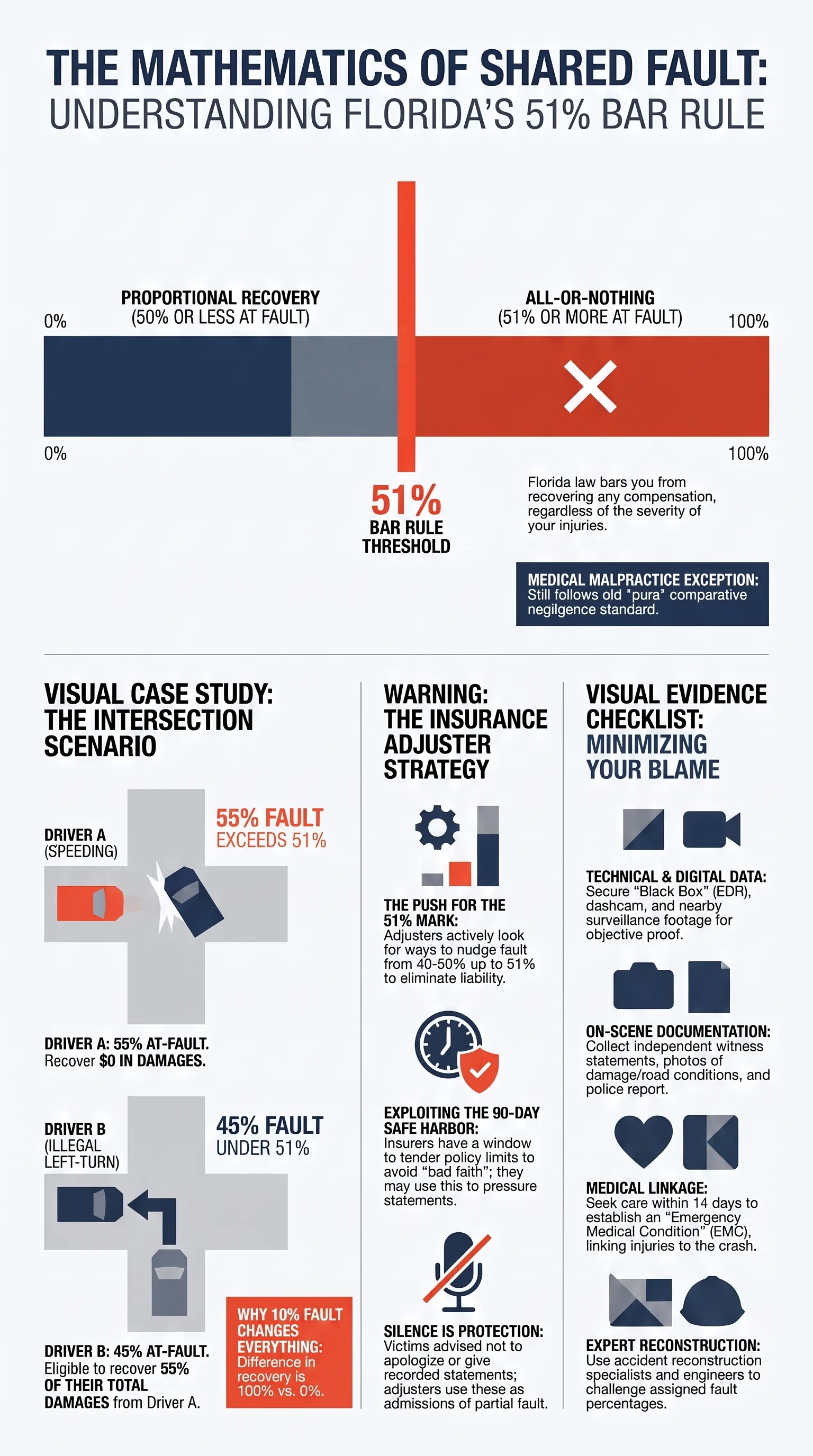
If you were hurt in a Florida car crash on or after March 24, 2023, one number now controls whether you recover money at all: your own share of the blame. Under a tort-reform law called HB 837, Florida switched from a system where you could always recover something to one where being found more than 50% at fault erases your claim entirely. This guide explains, in plain English, exactly what changed, why it matters for what you say and do after a wreck, and how the math works with real dollar examples.
The short version
- What changed: On March 24, 2023, Florida moved from pure comparative negligence to modified comparative negligence with a 51% bar.
- The new rule: If you are found more than 50% at fault for your own injuries, you recover nothing. If you are 50% at fault or less, you still recover, but your award is reduced by your fault percentage.
- The law: HB 837 amended Fla. Stat. § 768.81. The statute now says that a party found “greater than 50 percent at fault for his or her own harm may not recover any damages.”
- Big exception: This 51% bar does not apply to medical-malpractice claims, which keep the older pure comparative rule.
- Bonus change: The same law also cut the deadline to sue for most negligence cases from four years to two years.
This article is general education about Florida law, not legal advice about your specific case. Fault is decided on the facts, and small differences change outcomes. When money is on the line, talk to a licensed Florida attorney.
What “comparative negligence” even means
Car crashes are rarely 100% one person’s fault. Maybe the other driver ran a red light, but you were going a few miles over the limit. Maybe someone turned left in front of you, but you glanced at your phone a second too long. Comparative negligence is the legal system for splitting the blame into percentages and then adjusting the money accordingly.
Here is the core idea. First, a jury (or an insurance adjuster negotiating in the shadow of what a jury would do) decides your total damages — the full value of your medical bills, lost wages, vehicle damage, and pain and suffering. Second, that same jury assigns a percentage of fault to each person involved, and all the percentages add up to 100%. Third, your recovery is reduced by your own percentage of fault. If you are 20% to blame for a $50,000 injury, you collect $40,000 instead of the full $50,000.
Every state uses some version of this idea. The fight is always over one question: how much of your own fault is too much? That threshold is exactly what HB 837 changed.
Pure vs. modified: the one thing HB 837 changed
Before March 24, 2023, Florida was a pure comparative negligence state. “Pure” meant there was no cutoff. Even if you were 90% or 99% at fault, you could still recover the sliver that was the other party’s fault. A driver 80% to blame for a $100,000 injury could still walk away with $20,000.
After March 24, 2023, Florida is a modified comparative negligence state with a 51% bar. “Modified” means there is now a hard line. If your share of the fault climbs above 50% — that is, to 51% or more — you fall off a cliff and recover $0, no matter how badly you were hurt. At exactly 50% or below, the old proportional math still applies: you recover, minus your percentage.
That is the whole change in one sentence: Florida added a 51% off-switch. Everything at 50% and under works the same as before; everything above 50% now gets nothing.
| Feature | Before HB 837 (pure) | On/after March 24, 2023 (modified, 51% bar) |
|---|---|---|
| Governing rule | Pure comparative negligence | Modified comparative negligence |
| If you are 20% at fault | Recover 80% of damages | Recover 80% of damages (same) |
| If you are exactly 50% at fault | Recover 50% of damages | Recover 50% of damages (same) |
| If you are 51% at fault | Recover 49% of damages | Recover nothing ($0) |
| If you are 90% at fault | Recover 10% of damages | Recover nothing ($0) |
| Medical-malpractice claims | Pure comparative | Still pure comparative (carve-out) |
| Deadline to file most negligence suits | 4 years | 2 years |
The math, with real dollar examples
Numbers make this click faster than definitions. In every example below, assume a jury values the total injury at $100,000. Watch what your fault percentage does to your check under the old rule versus the new one.
- You are 10% at fault. Old law: $90,000. New law: $90,000. No change — you are well under the line.
- You are 40% at fault. Old law: $60,000. New law: $60,000. No change.
- You are 50% at fault. Old law: $50,000. New law: $50,000. Still no change — 50% is the last percentage that recovers.
- You are 51% at fault. Old law: $49,000. New law: $0. One percentage point past the line wipes out a $49,000 recovery.
- You are 60% at fault. Old law: $40,000. New law: $0.
- You are 90% at fault. Old law: $10,000. New law: $0.
Notice where the danger lives. The change costs you nothing until you cross 50%, and then it costs you everything. That is why the fight in a shared-fault crash is no longer just about shaving a few points off your recovery — it is often a battle over which side of the 50/51 line you land on. An adjuster who can push your fault from 45% to 51% does not save 6% of the claim; the insurer pays $49,000 less, which in that example is the entire remaining case.
Want to run your own numbers? Use our comparative-fault calculator to see how different fault percentages change your estimated recovery.
How fault percentages actually get assigned
No one hands out fault percentages at the crash scene. They get decided later, and several people take a swing at the number before a jury ever would:
- The police officer writes a crash report and may note a traffic-law violation or an opinion about contributing causes. It is not the final word, but it heavily influences everyone after.
- The insurance adjusters — yours and the other driver’s — assign fault internally to decide what to pay. This is where most cases are actually resolved, and where the 51% bar quietly does its work in settlement talks.
- Lawyers and, ultimately, a jury decide fault if the case is litigated. Under Florida’s statute, the jury allocates a percentage of fault to everyone who contributed, including non-parties.
What moves the number? The evidence: the police report, photos of the vehicles and roadway, skid marks and final resting positions, traffic-camera or dash-cam footage, witness statements, vehicle event-data (“black box”) records, and — critically — what each driver said afterward. Which brings us to the part you actually control.
Why the 51% bar changes what you say at the scene
Before 2023, an offhand “I’m so sorry, I didn’t see you” might trim your recovery a bit. Now, that same sentence can be the difference between a full case and a zero. When being 51% at fault means recovering nothing, every admission that nudges your fault upward is worth real money to the other side.
You are not lying or hiding anything by being careful. You are simply avoiding guesses and apologies that can be twisted into fault later. Practical rules for the scene:
- Do not apologize or admit blame. “I’m sorry” is human, but it gets quoted back as an admission. Check on people and be kind without narrating fault.
- Do not guess about speed, distance, or timing. “I was probably going about 50” becomes a fact in the file. If you do not know, say you do not know.
- Stick to facts, not conclusions. “The light was green for me” is a fact. “It was all my fault” is a conclusion — and not one you are qualified to make at the scene.
- Get independent evidence. Photos, the other driver’s information, and witness names and numbers protect you far better than any statement.
- Be careful with the other insurer. A recorded statement to the other driver’s insurance company is designed, in part, to build a fault percentage against you.
Common crash scenarios and how fault gets shared
Fault-splitting is easiest to understand through the everyday collisions where it actually happens.
Rear-end collisions
The rear driver is usually presumed at fault, because Florida drivers must keep a safe following distance. But that presumption can be rebutted — for example, if the front car cut in and “brake-checked,” had non-working brake lights, or reversed unexpectedly. Under the new law, if the lead driver is pushed to 51% fault for their own harm, they recover nothing, even in a crash where they were rear-ended.
Left-turn collisions
A driver turning left across traffic generally must yield to oncoming cars, so they often carry the larger share of fault. But if the oncoming driver was speeding, ran a red, or was distracted, fault gets split — and each driver’s recovery now hinges on staying at or below 50%.
Lane-change and merge crashes
These are classic shared-fault cases. One driver drifts over without checking a blind spot; the other was speeding or lingering in the blind spot. A jury might land at 60/40 or 55/45 — splits that used to mean a reduced check for both and now can mean a total bar for whoever tips over 50%.
Shared-fault pileups and intersection crashes
When three or more vehicles are involved, the jury allocates a percentage to each. Because the percentages must total 100%, everyone’s number is connected: pushing one driver up pushes others down. In these multi-party cases, the 51% bar makes the allocation fight especially high-stakes.
The medical-negligence exception
HB 837’s 51% bar has a notable carve-out. The statute states that the modified-comparative subsection does not apply to medical-malpractice claims — “an action for damages for personal injury or wrongful death arising out of medical negligence pursuant to chapter 766.” Those cases keep the older pure comparative negligence rule, so an injured patient found more than 50% at fault can still recover the portion attributable to the provider. This carve-out is narrow: it does not help you in an ordinary car-crash case, which is squarely governed by the new 51% bar.
The other half of HB 837: your deadline got shorter
The comparative-negligence change grabbed headlines, but the same law quietly did something just as dangerous to unwary crash victims: it cut the statute of limitations. For most general-negligence claims — including typical car-accident injury cases — HB 837 amended Fla. Stat. § 95.11 to shorten the filing deadline from four years to two years from the date the cause of action accrued (generally, the crash date) for accidents on or after March 24, 2023.
Why it matters together with the fault rule: even a rock-solid, low-fault case is worth zero if you file it too late. Two years sounds like plenty, but medical treatment, insurance back-and-forth, and life have a way of eating it. Learn the details in our guide to the Florida car-accident statute of limitations.
Does the new rule even apply to my case?
Timing is everything. The 51% bar applies to causes of action that accrued on or after March 24, 2023 — in plain terms, crashes that happened that day or later. If your crash predates March 24, 2023, the older pure comparative rule generally still governs your claim, meaning you could recover a reduced amount even if you were more than half at fault. Because these accrual and transition questions can get technical, confirm your specific situation with a Florida attorney before assuming which rule applies.
How to protect your recovery under the 51% bar
- Report and document early. Call the police, get a report number, and photograph everything — vehicles, positions, road signs, skid marks, and injuries.
- Get medical care promptly and follow through. Gaps in treatment get used to argue your injuries were not serious — and, combined with Florida’s no-fault PIP rules, prompt care also protects your benefits. See our guide to Florida PIP and no-fault coverage.
- Collect witnesses. A neutral witness who saw the other driver run the light can single-handedly keep you under 50%.
- Watch your words with the other insurer. You are generally not required to give the other driver’s insurance company a recorded statement; anything you say there can feed a fault percentage against you.
- Mind the two-year clock. Do not let the shorter deadline lapse while you are still negotiating.
- Get a case evaluation if fault is contested. When you are anywhere near the 50% line, professional help is not a luxury — it is the difference between a full recovery and nothing.
The bottom line: Florida’s 51% comparative-negligence bar turned fault percentages from a discount into a cliff. Understanding where that cliff sits — and being careful not to talk yourself over the edge — is now one of the most valuable things you can do after a crash.
Frequently asked questions
What is Florida's 51% comparative negligence bar?
It is a rule created by HB 837 in 2023. If a jury decides you were more than 50% at fault for your own injuries, you are barred from recovering any damages at all. If you are 50% at fault or less, you still recover, but your award is reduced by your percentage of fault.
When did the 51% bar take effect?
Governor DeSantis signed HB 837 into law on March 24, 2023, and it took effect the same day. It applies to causes of action that accrued on or after that date, meaning crashes that happened March 24, 2023 or later.
How is this different from Florida's old comparative negligence law?
Before HB 837, Florida used pure comparative negligence, which had no cutoff. You could recover a reduced amount even if you were 90% or 99% at fault. Now, with modified comparative negligence, anyone found more than 50% at fault recovers nothing.
If I am 60% at fault for a $100,000 injury, what do I get?
Under the old pure rule you would have recovered $40,000 (the 40% that was not your fault). Under the new 51% bar you recover $0, because you are more than 50% at fault.
What happens if I am exactly 50% at fault?
Fifty percent is the last percentage that still recovers. At exactly 50% at fault, you recover 50% of your damages. The bar only kicks in above 50%, at 51% or more.
Does the 51% bar apply to medical malpractice cases?
No. The statute carves out claims arising from medical negligence under chapter 766. Those cases keep the older pure comparative negligence rule, so a patient found more than 50% at fault can still recover a reduced amount.
Did HB 837 change the deadline to file a lawsuit too?
Yes. The same law amended Fla. Stat. section 95.11 to shorten the statute of limitations for most negligence claims from four years to two years, for causes of action accruing on or after March 24, 2023. Even a strong, low-fault case is worth nothing if you file too late.
Who decides my percentage of fault?
Insurance adjusters assign fault when negotiating a settlement, and if the case goes to court, a jury decides. They rely on the police report, photos, video, witness statements, vehicle data, and statements the drivers made after the crash.
Does the new rule apply if my crash happened before March 24, 2023?
Generally no. Crashes that occurred before March 24, 2023 are typically governed by the old pure comparative negligence rule, under which you could recover a reduced amount even if you were more than half at fault. Confirm your specific situation with a Florida attorney.
How can I keep my fault percentage below the 51% line?
Avoid apologies and guesses at the scene, stick to facts rather than conclusions, gather photos and witness contacts, get prompt medical care, be cautious with the other driver's insurer, and get a professional case evaluation when fault is contested.
Put this to work on your own case
Free, private tools that track your Florida deadlines, estimate what you'd actually keep after fees, and draft your claim — no account, nothing leaves your phone.
Start here
Related guides
Related reports
This is general information about Florida law, not legal advice. Every crash is different — for advice about your situation, talk to a licensed Florida attorney. Reviewed August 6, 2026.