Florida PIP & No-Fault Insurance, Fully Explained
How Florida's no-fault system and $10,000 Personal Injury Protection really work — what PIP pays, the 14-day and EMC rules, and when you can sue the at-fault driver.
If you drive in Florida, you already own a piece of one of the most misunderstood insurance systems in the country. It has a plain-sounding name, no-fault, and a plain-sounding acronym, PIP (Personal Injury Protection). But the way it actually works surprises almost everyone the first time they are in a crash. The single most common shock: after someone else runs a red light and hits you, it is usually your own insurance company, not theirs, that pays your first medical bills.
This guide explains the whole system in plain English, with real dollar amounts, so you understand what you are covered for, who pays, and when you can go after the driver who hurt you. It is educational information about how Florida law works, not legal advice about your specific situation.
The big idea: why Florida chose "no-fault"
Florida is a no-fault state. That phrase does not mean nobody is at fault for the crash. It means the law does not want to wait for a fault fight before your basic medical bills get paid. Under the Florida Motor Vehicle No-Fault Law, every injured person turns to their own auto policy first for a set of guaranteed benefits, regardless of who caused the wreck.
The trade-off is written into the statutes. In exchange for fast, guaranteed benefits (the no-fault "bargain"), the law also limits your right to sue the at-fault driver for pain and suffering unless your injuries are serious enough to cross a legal threshold. Florida spells this out in Fla. Stat. § 627.7407 (which keeps the No-Fault Law in force) and Fla. Stat. § 627.736 (the PIP benefits themselves). The goal was to reduce small lawsuits and get accident victims treated quickly. Whether it succeeds is debated, but the mechanics are what you need to know.
What Florida actually requires you to carry
To register a car with at least four wheels in Florida, the state requires just two coverages:
- $10,000 in Personal Injury Protection (PIP) — pays for your injuries, no matter who caused the crash.
- $10,000 in Property Damage Liability (PDL) — pays for damage you cause to other people's property (their car, a fence, a storefront).
Here is the part that stuns most people: Florida does not require you to carry Bodily Injury Liability (BI) coverage. BI is the coverage that pays for the other person's injuries when you cause a crash. Florida is one of the very few states that does not mandate it for ordinary drivers (some drivers are required to carry it after a DUI or certain at-fault crashes). The Florida Department of Highway Safety and Motor Vehicles confirms the bare minimum is $10,000 PIP + $10,000 PDL, and nothing more.
That gap matters enormously. It means the driver who hits you may legally have zero coverage for your medical bills beyond your own PIP. We will come back to why that makes uninsured/underinsured motorist coverage so important.
What your PIP actually pays: the 80 / 60 / $5,000 split
Your $10,000 of PIP is not a blank check. Section 627.736 divides it into specific categories and pays specific percentages. Understanding the split is the difference between expecting $10,000 in your pocket and understanding what really lands.
Medical bills: 80%
PIP pays 80% of your reasonable and necessary medical expenses — the ER visit, X-rays, the orthopedist, physical therapy, prescriptions. You (or your health insurer) are responsible for the other 20%.
Example: You run up $9,000 in medical bills. PIP pays 80%, or $7,200. The remaining $1,800 is yours to cover, unless you have health insurance or MedPay to pick it up.
Lost wages: 60%
If your injuries keep you from working, PIP replaces 60% of your lost gross income and lost earning capacity. It does not pay 100% of your paycheck.
Example: You normally earn $1,000 a week and miss three weeks. Your gross lost wages are $3,000; PIP pays 60%, or $1,800.
The combined cap
Critically, medical and lost-wage benefits share the same $10,000 pool. They are not separate buckets. If big medical bills eat the whole $10,000, there is nothing left in PIP for lost wages. Serious injuries blow through $10,000 fast — which is exactly why the right to sue (below) exists.
Death benefit: $5,000
Separately, PIP provides a $5,000 death benefit per person, paid on top of (not out of) the $10,000 medical/disability limit.
The 14-day rule: the deadline that quietly voids benefits
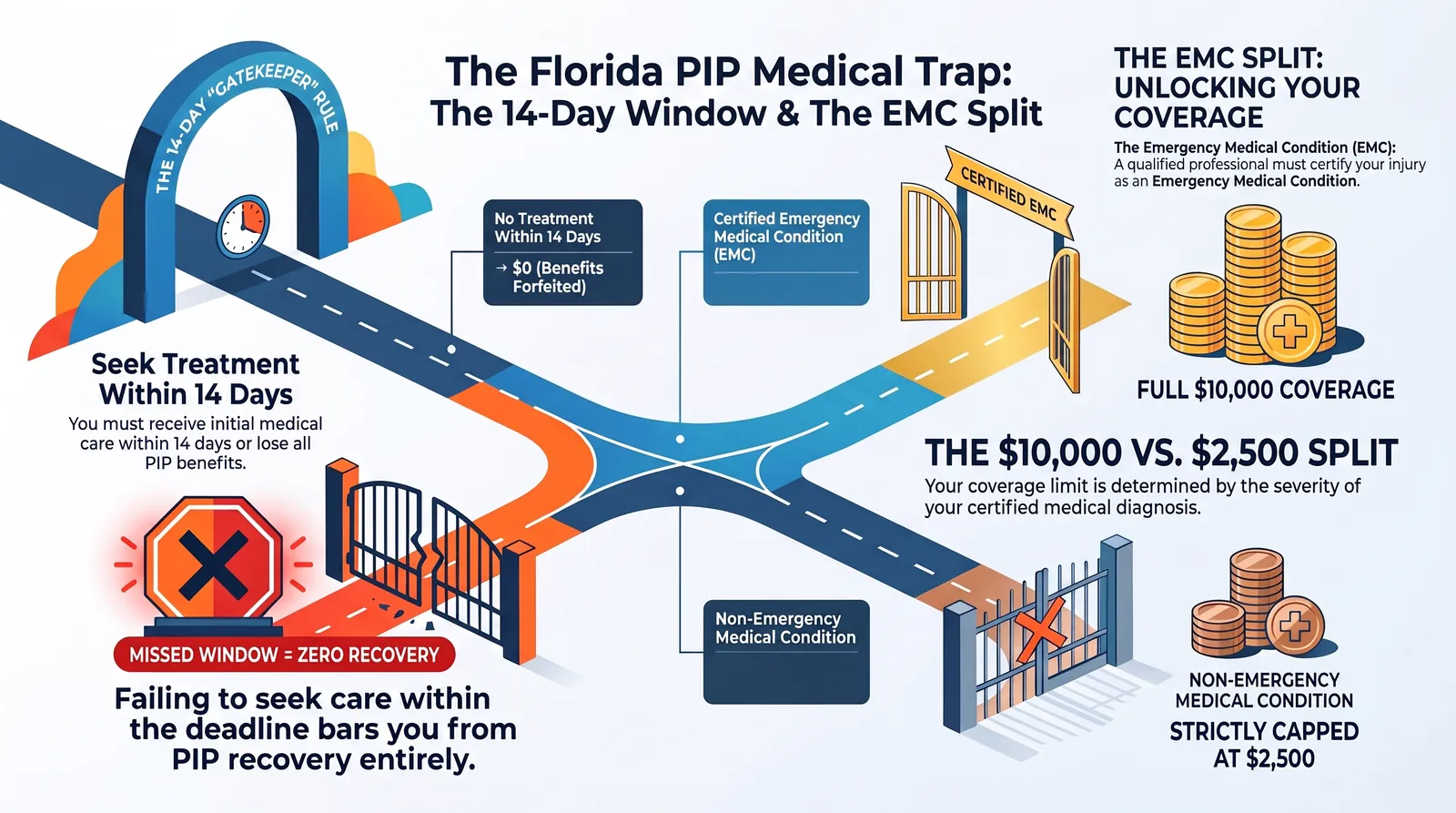
This is the trap that costs Florida drivers their coverage more than any other. To be eligible for any PIP medical benefits, you must receive your initial medical care within 14 days of the accident. Wait until day 15 to see a doctor, and the statute cuts off your PIP medical benefits entirely — even if you were genuinely hurt.
The takeaway is simple: after a crash, get evaluated promptly, even if you feel "just sore." Whiplash and soft-tissue injuries often do not flare up until days later, and by then the clock may have run. We cover this in depth in our companion guide on the 14-day rule.
EMC: the $10,000-vs-$2,500 fork in the road
Even if you treat within 14 days, whether you get the full $10,000 or only $2,500 depends on a medical finding called an Emergency Medical Condition (EMC).
- If a qualifying provider (a physician, osteopath, dentist, physician's assistant, advanced practice nurse, or hospital) determines you have an EMC, you get the full $10,000 in PIP medical benefits.
- If no provider documents an EMC, your PIP medical benefits are capped at $2,500.
An EMC is, roughly, a condition serious enough that without immediate care you could expect serious jeopardy to your health. This determination is a formal medical finding that must appear in your records — it is not automatic, and chiropractors and massage therapists cannot make it. This one line in a doctor's chart can be worth $7,500, so it matters that your treating provider addresses it.
Deductibles: your first dollars
PIP policies can carry a deductible (commonly $250, $500, or $1,000) that you choose when you buy the policy. A higher deductible lowers your premium but means you absorb more before PIP starts paying. The deductible applies before the 80% and 60% percentages, so a $1,000 deductible reduces the pool available for your bills.
Who your PIP covers (it is broader than you think)
Your PIP does not only cover you behind the wheel of your own car. Under § 627.736 it generally follows the person, not just the vehicle. Your policy typically covers:
- You, whether you are driving your car, driving someone else's car, or riding as a passenger.
- Relatives who live in your household and do not own their own car (and therefore their own PIP).
- Passengers in your car who do not have their own PIP.
- Pedestrians and cyclists who are Florida residents struck by your vehicle, if they have no PIP of their own.
So if your teenager is hurt riding in a friend's car, or you are struck by a car while crossing the street, your own PIP is often the coverage that responds. This "follows the person" feature is why a household can be protected even when the at-fault driver carries nothing. Motorcyclists are the notable exception: motorcycles are not "motor vehicles" for PIP purposes, so a rider hurt on a bike generally cannot use PIP for those injuries.
How to actually use your PIP after a crash
Knowing the rules is one thing; using them under stress is another. Here is the practical sequence that keeps your benefits intact.
- Report the crash to your own insurer promptly. PIP is a claim against your policy, so your carrier needs to open a claim and assign a number even though you were not at fault. Do this within the first few days.
- Get medical care inside the 14-day window. Go to an ER, urgent care, or your doctor. Make sure the provider is one whose treatment qualifies for PIP, and ask that they document an emergency medical condition if one exists.
- Complete the paperwork. Your insurer will send forms, often including a sworn statement and an authorization to obtain your records. PIP benefits can be delayed or denied if these are not returned.
- Keep every record. Save bills, mileage to appointments (PIP can reimburse it), and proof of lost wages from your employer. Lost-wage claims usually require a written wage statement.
- Coordinate with health insurance. Once PIP's $10,000 is exhausted, your health insurance typically covers the rest of your medical care. Give providers both policies so bills route correctly.
Providers are supposed to bill PIP directly, but errors are common. If a bill lands in your mailbox, do not ignore it — forward it to your PIP adjuster and confirm it was submitted before any deadline lapses.
The misconception that costs people the most
Here is the belief almost every new client walks in with, and it is usually wrong:
"The other driver caused the crash, so their insurance will pay my medical bills."
In Florida, at the start of a claim, that is normally false. Because of no-fault, your own PIP pays first, regardless of who was at fault. The at-fault driver's insurer does not cut you a check for your medical bills up front. And remember — Florida does not even require that driver to carry Bodily Injury coverage, so there may be no policy of theirs to reach for your injuries at all.
You only get to the at-fault driver's insurance (or your own uninsured-motorist coverage) after your injuries cross the serious-injury threshold and you pursue a liability claim. Until then, no-fault means "look to your own policy first."
A real claim, start to finish (with dollars)
Let's walk a realistic Florida crash all the way through.
The crash. A driver rear-ends you at a light. Clearly their fault. You feel shaken but drive home. Two days later your neck and lower back are worse, so you see a doctor — within the 14-day window. Good.
PIP kicks in. Your doctor documents an emergency medical condition, unlocking the full $10,000. Over the next two months you accumulate:
- ER and imaging: $4,000
- Orthopedist and physical therapy: $8,000
- Three weeks of missed work at $1,000/week gross: $3,000 lost wages
What PIP pays. Medical bills total $12,000; PIP pays 80% but only until the $10,000 pool is exhausted. In practice, 80% of your medical bills alone ($9,600) nearly drains the pool, leaving almost nothing for the 60% lost-wage benefit. Your $10,000 is gone, and you still have unpaid medical balances plus most of your lost wages uncovered.
Stepping outside no-fault. Your injuries are significant and, per your doctor, likely permanent. That lets you cross the threshold and file a liability (bodily injury) claim against the at-fault driver. Now their BI coverage — if they carry any — is on the hook for your remaining medical bills, your full lost wages, and pain and suffering, which PIP never pays.
If they have no BI coverage. This is common in Florida. If the at-fault driver is uninsured or carries too little, you turn to your own Uninsured/Underinsured Motorist (UM/UIM) coverage — if you bought it. This is the moment people wish they had.
When you can sue: the serious-injury threshold
You cannot sue the at-fault driver for pain and suffering over a minor fender-bender. Florida's tort threshold, in Fla. Stat. § 627.737, lets you "step outside" no-fault and pursue non-economic damages only if your injury falls into one of four categories:
- Significant and permanent loss of an important bodily function (for example, loss of use of a limb, vision, or hearing).
- Permanent injury within a reasonable degree of medical probability (other than scarring or disfigurement).
- Significant and permanent scarring or disfigurement.
- Death.
Meet one of these, and you can recover economic damages beyond PIP (remaining medical bills, full lost wages, future care) and non-economic damages (pain, suffering, mental anguish, loss of enjoyment of life). Fall short, and no-fault keeps you inside the PIP system.
How HB 837 (2023) changed the fight over fault
Once you are pursuing the at-fault driver, Florida's 2023 tort-reform law, HB 837, shapes what you can recover:
- Modified comparative negligence (the 51% bar). If a jury finds you more than 50% at fault for your own injuries, you recover nothing. At 50% or less, your recovery is reduced by your share of fault. (Before March 24, 2023, Florida used "pure" comparative negligence, where even a 90%-at-fault plaintiff could recover 10%.)
- Shorter deadline to sue. HB 837 cut the statute of limitations for general negligence from four years to two years for causes of action accruing on or after March 24, 2023. Miss that window and your claim is generally gone forever.
We cover the fault rules in detail in our comparative-negligence guide. The headline: document the crash thoroughly and do not wait to act.
PIP vs BI vs UM/UIM vs MedPay: who pays for what
These four coverages are constantly confused. Here is how they line up.
| Coverage | Whose injuries it pays for | Required in Florida? | Depends on fault? | Pays pain & suffering? |
|---|---|---|---|---|
| PIP (Personal Injury Protection) | You and your household/passengers | Yes — $10,000 minimum | No — pays regardless of fault | No |
| BI (Bodily Injury Liability) | The other people you injure | No (except after certain violations) | Yes — pays when you are at fault | Yes (to the people you hurt) |
| UM/UIM (Uninsured/Underinsured Motorist) | You, when the at-fault driver has no/too little BI | No (optional, but strongly advised) | Yes — steps in when the other driver is liable | Yes |
| MedPay (Medical Payments) | You and your passengers | No (optional add-on) | No | No |
How UM/UIM and MedPay fill the gaps
UM/UIM is the coverage Florida drivers most often wish they had bought. Because BI is optional here, a huge share of at-fault drivers carry little or no coverage for your injuries. UM/UIM turns your own policy into the backstop, paying your damages — including pain and suffering — as if the at-fault driver had proper insurance. If you buy only one optional coverage, most attorneys will tell you to make it this one.
MedPay is a smaller, optional add-on that helps cover the 20% of medical bills PIP does not pay, plus your deductible, without regard to fault. For a modest premium, it can spare you out-of-pocket medical costs while your claim plays out.
Common mistakes that shrink or sink a claim
- Waiting more than 14 days to get care. This alone can void your PIP medical benefits.
- Assuming the other driver's insurance pays your bills. Your PIP pays first, and the other driver may carry no BI at all.
- Skipping the EMC determination. Without it, you are capped at $2,500 instead of $10,000.
- Declining UM/UIM to save a few dollars. In a state where BI is optional, this is the coverage that protects you from everyone else's gaps.
- Treating $10,000 as "plenty." Serious injuries exhaust it quickly; the real recovery for a serious crash comes through the liability or UM/UIM claim.
- Sitting on a claim. Since HB 837, you generally have just two years to sue.
The bottom line
Florida's no-fault system is built to get you treated fast: your own $10,000 PIP pays 80% of medical bills and 60% of lost wages regardless of fault, as long as you treat within 14 days and get an EMC finding. But $10,000 rarely covers a serious injury, the at-fault driver may carry no coverage for you at all, and you can only reach them (and pain-and-suffering damages) if your injury crosses the § 627.737 threshold. Knowing which coverage pays, in what order, is what turns a confusing claim into a recovered one. If your injuries are significant, it is worth talking with a Florida injury attorney about your options.
Frequently asked questions
Does the at-fault driver's insurance pay my medical bills in Florida?
Usually not at first. Because Florida is a no-fault state, your own Personal Injury Protection (PIP) pays your initial medical bills regardless of who caused the crash. You can only pursue the at-fault driver's Bodily Injury coverage after your injuries cross the serious-injury threshold in Fla. Stat. § 627.737 — and Florida doesn't even require drivers to carry Bodily Injury coverage, so there may be no policy of theirs to reach.
How much does PIP actually pay?
PIP provides up to $10,000, paying 80% of reasonable and necessary medical expenses and 60% of lost wages. Those two categories share the same $10,000 pool, so large medical bills can use it all up. There is also a separate $5,000 death benefit paid on top of the $10,000 limit.
What is the 14-day rule?
Under Fla. Stat. § 627.736, you must receive your initial medical care within 14 days of the accident to be eligible for any PIP medical benefits. Wait until day 15 and you can lose PIP medical coverage entirely, even if you were genuinely injured. See a doctor promptly, even if you only feel sore.
What is an Emergency Medical Condition (EMC) and why does it matter?
An EMC is a formal determination by a qualifying medical provider that your condition is serious enough to require immediate care. If a provider documents an EMC, you get the full $10,000 in PIP medical benefits. Without an EMC finding, your PIP medical benefits are capped at just $2,500.
Is Bodily Injury liability insurance required in Florida?
No. Florida only requires $10,000 in PIP and $10,000 in Property Damage Liability. Bodily Injury (BI) liability — which pays for injuries you cause to others — is not mandatory for ordinary drivers, though it may be required after a DUI or certain at-fault crashes. This is why many at-fault drivers have no coverage for your injuries.
When can I sue the driver who hit me?
Florida's no-fault law limits lawsuits for pain and suffering. Under Fla. Stat. § 627.737 you can step outside no-fault and sue only if your injury involves significant and permanent loss of an important bodily function, permanent injury within a reasonable degree of medical probability, significant and permanent scarring or disfigurement, or death.
How did HB 837 change things?
Florida's 2023 tort-reform law (HB 837) adopted modified comparative negligence: if you're found more than 50% at fault for your own injuries, you recover nothing. It also shortened the statute of limitations for negligence from four years to two years for claims accruing on or after March 24, 2023.
Does my PIP cover me as a passenger or pedestrian?
Yes. Florida PIP generally follows the person, not just the car. It typically covers you as a driver, passenger, or pedestrian, plus relatives in your household and passengers in your car who don't have their own PIP. If you're struck as a pedestrian or cyclist, your own PIP often responds.
What is the difference between UM/UIM and MedPay?
Uninsured/Underinsured Motorist (UM/UIM) coverage protects you when the at-fault driver has no or too little Bodily Injury coverage — it can pay your damages including pain and suffering. MedPay is a smaller add-on that helps cover the 20% of medical bills PIP doesn't pay, plus your deductible, regardless of fault. Both are optional but valuable.
Is $10,000 of PIP enough?
For a minor crash, often yes. For a serious injury, rarely. Medical bills and lost wages share one $10,000 pool that a significant injury exhausts quickly. Real compensation for a serious crash usually comes through a liability claim against the at-fault driver or through your own UM/UIM coverage — not from PIP alone.
Put this to work on your own case
Free, private tools that track your Florida deadlines, estimate what you'd actually keep after fees, and draft your claim — no account, nothing leaves your phone.
Start here
Related guides
Related reports
This is general information about Florida law, not legal advice. Every crash is different — for advice about your situation, talk to a licensed Florida attorney. Reviewed August 6, 2026.