Uninsured & Underinsured Motorist Coverage in Florida
Florida doesn't require drivers to carry any bodily-injury insurance — so if someone seriously hurts you, there may be nothing to claim against. UM/UIM coverage is the one policy that protects you from that gap. Here's how it works and why the court record shows you need it.
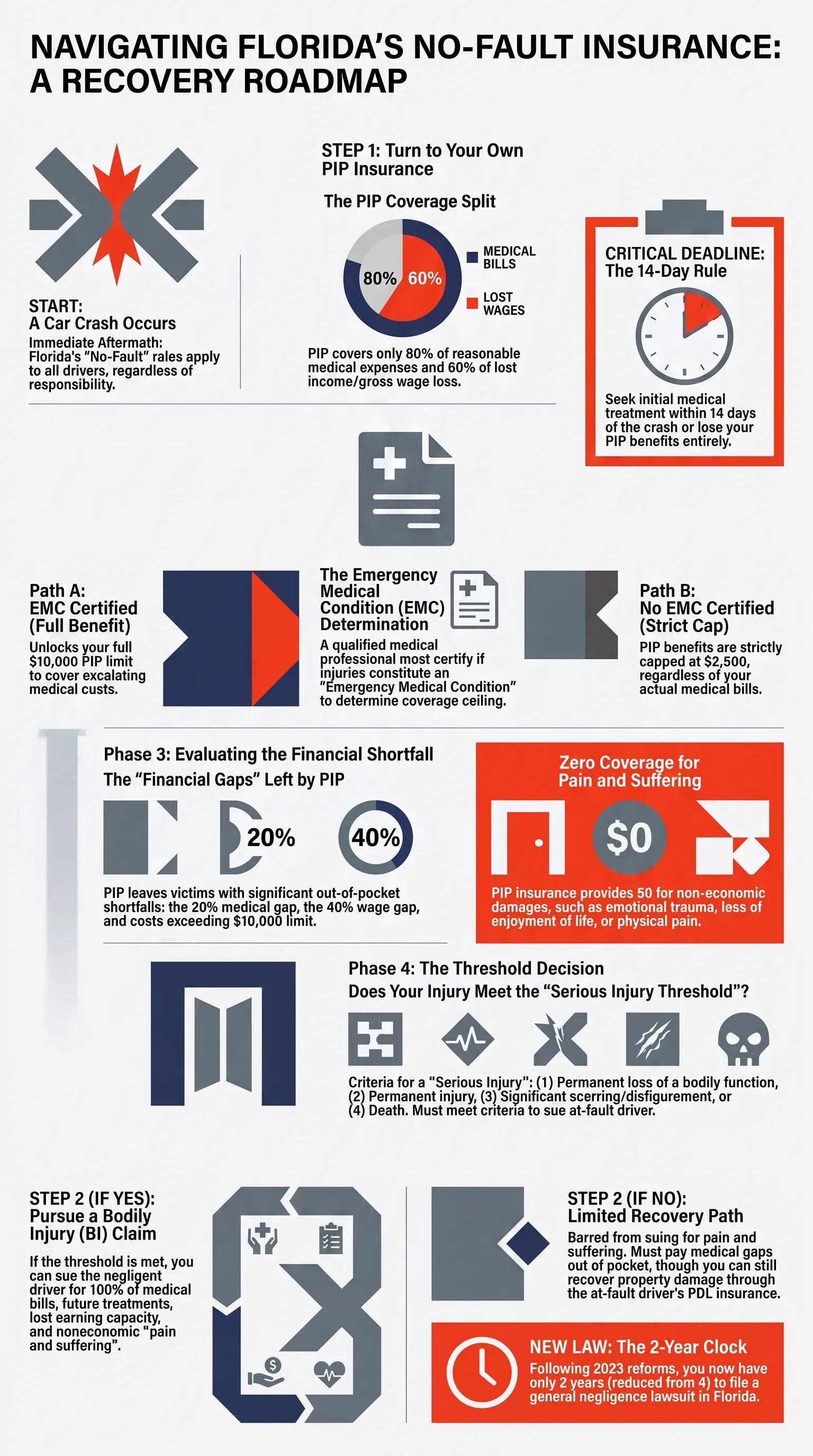
Here's a fact that surprises almost every Floridian who hasn't been through a bad crash: Florida does not require drivers to carry any bodily-injury liability insurance. The state only mandates $10,000 of Personal Injury Protection (PIP) and $10,000 of property-damage liability. That means the driver who runs a red light and breaks your back may be carrying exactly zero dollars of coverage for the harm they do to your body — and be completely legal doing it.
So who pays when that happens? If you did the one thing most people skip, the answer is: your own uninsured/underinsured motorist (UM/UIM) coverage. This guide explains what UM is, why Florida's unusual rules make it the single most important coverage you can buy, how 'stacking' multiplies it, and the traps that can quietly destroy your claim. It's educational, not legal advice — but by the end you'll understand why so many injured Floridians end up making a claim against their own insurance company.
Why Florida is different (and more dangerous)
Most states require drivers to carry bodily-injury liability — coverage that pays for injuries they cause to other people. Florida is one of the very few that doesn't. Combined with a high rate of drivers who carry only the bare legal minimum (or nothing at all), the result is a state full of at-fault drivers who can't cover the damage they do.
Florida's no-fault system makes this worse. Your $10,000 of PIP pays 80% of your medical bills and 60% of lost wages regardless of who caused the crash — but $10,000 disappears fast with a real injury, and PIP pays nothing for pain and suffering. To reach beyond PIP for a serious injury, you normally pursue the at-fault driver. And if that driver has no bodily-injury coverage, there's nothing to pursue... unless you carry UM.
What UM/UIM actually covers
Uninsured/underinsured motorist coverage is first-party coverage — it's on your policy, and you claim against your own insurer. In Florida the same coverage handles two situations:
- Uninsured (UM): the at-fault driver had no bodily-injury liability coverage at all, or was a hit-and-run / 'phantom' driver who fled the scene.
- Underinsured (UIM): the at-fault driver had bodily-injury coverage, but not enough to cover your injuries. Your UM makes up the difference above their limit.
What it pays for is the injury side of a crash that PIP doesn't fully cover:
- Medical bills beyond your PIP (and beyond the at-fault driver's limits)
- Lost wages beyond the 60% PIP covers
- Pain, suffering, and loss of enjoyment of life
- Future medical care and future lost earning capacity for lasting injuries
Note what it does not cover: your car. UM is for bodily injury. Damage to your vehicle from an uninsured driver is a separate, optional coverage called Uninsured Motorist Property Damage (UMPD), or is handled through your collision coverage.
What the court record shows
This isn't theoretical. When we analyzed a full year of crash and injury lawsuits from Hillsborough County (Tampa) — tens of thousands of public filings — we separated the serious injury cases brought by actual individuals and looked at who they had to sue. Roughly one in four of those serious suits involved the victim's own insurance company: about 9% were filed purely against the injured person's own carrier, and another 16% named their own insurer alongside the at-fault party. (You can read the full breakdown in our Crash Data Journalism report.)
Read that again: in a quarter of serious crash lawsuits, the injured person had to fall back on their own policy because the other driver's coverage wasn't enough — or didn't exist. That is precisely the scenario UM/UIM is built for, and the people who didn't buy it had nothing to fall back on.
How much UM can you get — and the written-rejection rule
Florida law (section 627.727) gives you real protection here, if you know it:
- UM must be offered equal to your bodily-injury limits. When you buy BI liability, your insurer must offer you UM in the same amount.
- You can only reject or reduce UM in a signed writing. A verbal 'no thanks' isn't valid. The rejection has to be on an approved form, signed by you.
- If there's no valid written rejection, the law can add UM equal to your BI limits by default. Insurers who cut corners on the paperwork have had UM read into policies they thought excluded it.
The practical takeaway: if you're not sure whether you have UM, or how much, pull your declarations page and look for 'Uninsured Motorist' or 'UM/UIM' with a dollar limit. If it says 'rejected' but you don't remember signing anything, that's worth a closer look.
Stacked vs. non-stacked UM
Florida lets you buy UM in two flavors:
- Non-stacked: your UM limit is a single flat amount, no matter how many cars you insure.
- Stacked: your UM limit is multiplied by the number of vehicles on your policy. Insure three cars with $50,000 stacked UM, and you effectively carry $150,000 of UM protection. Stacked UM can also apply when you're injured in a vehicle you don't own (as a passenger, or in a rental).
Stacked coverage costs more, but for many families it's the difference between real protection and a token amount. If you carry more than one vehicle, ask your agent what stacked UM would cost — it's often less than people expect.
A worked example
Say a distracted driver runs a light and T-bones you. You have surgery, miss two months of work, and your total damages — medical bills, lost wages, and pain and suffering — come to $120,000.
- Your PIP pays up to $10,000 of medical and wage loss, regardless of fault. Balance remaining: ~$110,000.
- The at-fault driver's BI coverage: they carry the Florida reality — $0 in bodily-injury liability. There is nothing to claim from them, and suing a person with no insurance and no assets usually recovers nothing.
- Your UM coverage: if you carry $100,000 in UM (stacked across two cars = $200,000), your own insurer steps into the shoes of the missing coverage and pays your injury damages up to that limit. Suddenly the same crash goes from a near-total loss to substantially covered.
Now run it again with no UM: PIP pays $10,000, the at-fault driver has nothing, and you personally absorb the remaining $110,000. Same crash. The only variable is whether you bought UM.
The trap that destroys UM claims: settling too soon
This is the mistake that costs people their UM coverage, so read carefully. When the at-fault driver does have some BI coverage but not enough (an underinsured case), you'll often be offered their policy limit as a settlement. Do not accept it and sign a release before notifying your own UM insurer.
Florida law (section 627.727(6)) gives your UM carrier a right to be told about the proposed settlement and a short window to either approve it or 'buy out' the claim to protect its subrogation rights against the at-fault driver. If you settle and release the at-fault driver without giving your UM insurer that notice and consent, you can forfeit your right to collect UM. The correct sequence is: get the at-fault limits offer in writing, notify your UM carrier, get written consent, then settle — and then pursue UM for the rest.
Hit-and-run and 'phantom' drivers
UM also covers you when the at-fault driver flees and is never identified — a hit-and-run — or when a 'phantom vehicle' runs you off the road without contact. These claims carry extra proof requirements (Florida generally wants some corroboration beyond your own word, and prompt reporting to police), so if you're hit by a driver who takes off, report it immediately and document everything.
How to add or increase UM today
- Find your declarations page (the summary your insurer sends at renewal). Look for a UM/UIM line and its limit.
- If it says rejected or is missing, call your agent and ask to add UM equal to your bodily-injury limits — stacked, if you insure more than one vehicle.
- If your BI limits are low, consider raising them; UM is tied to BI, so higher BI unlocks higher UM.
- Get the new limit in writing and keep the declarations page. This is the cheapest serious-injury protection available to a Florida driver, and it protects you no matter whose fault the crash is or whether the other driver bothered to insure themselves.
Deadlines
Don't sit on a claim. Since HB 837 took effect on March 24, 2023, most Florida negligence claims carry a 2-year statute of limitations, so the underlying injury case moves on a tight clock. A UM claim is based on your insurance contract and generally has a longer window, but the two are intertwined — evidence fades, and settling the at-fault side without protecting UM (above) can end the UM claim early. Treat 2 years from the crash as your working deadline and start early. When in doubt, talk to a licensed Florida attorney about your specific policy and timeline.
The bottom line
Florida lets drivers hurt you without carrying a dime of coverage for your injuries, and the court record shows a quarter of serious crash victims end up leaning on their own insurance as a result. UM/UIM is the coverage that makes sure 'their fault, no insurance' doesn't become 'your problem, no recovery.' If you check one thing on your policy this year, make it this.
This guide is educational and not legal advice. Coverage terms vary by policy; for advice about your specific situation, consult a licensed Florida attorney or your insurance agent.
Frequently asked questions
Is uninsured motorist coverage required in Florida?
No. Florida only requires $10,000 of PIP and $10,000 of property-damage liability. UM/UIM is optional — but because Florida also doesn't require bodily-injury liability, UM is often the only coverage that will pay for your injuries when an uninsured or underinsured driver hurts you. Insurers must offer it to you equal to your bodily-injury limits, and you can only decline or reduce it in a signed writing.
What's the difference between uninsured and underinsured motorist coverage?
In Florida they're the same coverage handling two situations. 'Uninsured' applies when the at-fault driver had no bodily-injury coverage at all (or was a hit-and-run). 'Underinsured' applies when they had some coverage but not enough to cover your injuries — your UM pays the difference above their limit.
Does UM coverage pay for my car?
No. UM covers bodily injury — medical bills, lost wages, and pain and suffering. Damage to your vehicle from an uninsured driver is handled by a separate optional coverage called Uninsured Motorist Property Damage (UMPD) or by your collision coverage.
What is stacked uninsured motorist coverage?
Stacked UM multiplies your UM limit by the number of vehicles on your policy. If you insure three cars with $50,000 stacked UM, you effectively carry $150,000 of UM protection, and it can also follow you into vehicles you don't own. It costs more than non-stacked UM but provides substantially more protection.
Can I make an uninsured motorist claim against my own insurance?
Yes — that's exactly what UM is. It's first-party coverage on your own policy, so you claim against your own insurer when an uninsured or underinsured driver injures you. In our analysis of a year of Tampa crash lawsuits, roughly one in four serious injury suits involved the victim's own insurer.
Can settling with the at-fault driver hurt my UM claim?
Yes, and this is a common and costly mistake. Before accepting an at-fault driver's insurance settlement and signing a release, you must notify your own UM carrier and get its consent (Florida statute 627.727(6)). Settling and releasing the at-fault driver without that notice can forfeit your right to collect UM. Get the offer in writing, notify your UM insurer, get written consent, then settle.
Does UM cover hit-and-run accidents in Florida?
Yes. UM covers you when the at-fault driver flees and is never identified, and in some cases when an unidentified 'phantom vehicle' causes the crash without contact. These claims have extra proof requirements, so report the crash to police immediately and document everything.
How much does uninsured motorist coverage cost in Florida?
It varies by driver and limits, but UM is generally inexpensive relative to the protection it provides — often a modest addition to a policy that can mean the difference between recovering six figures for a serious injury and recovering nothing. Ask your agent for a quote at limits equal to your bodily-injury coverage, both stacked and non-stacked.
Put this to work on your own case
Free, private tools that track your Florida deadlines, estimate what you'd actually keep after fees, and draft your claim — no account, nothing leaves your phone.
Start here
Related guides
Related reports
This is general information about Florida law, not legal advice. Every crash is different — for advice about your situation, talk to a licensed Florida attorney. Reviewed August 9, 2026.